


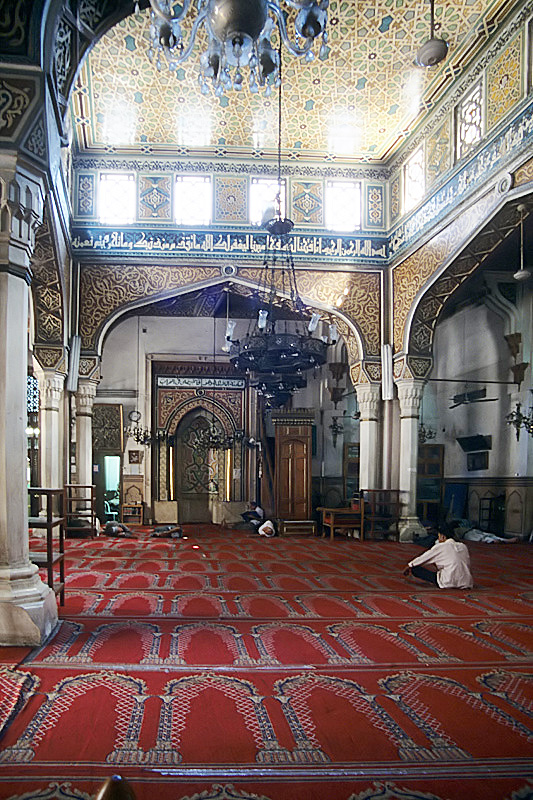
Discover the history of Al-Attarine, one of Alexandria’s oldest districts, and explore the legacy of its iconic mosque and Sufi heritage.
By Nevine Serag
In the dense heart of old Alexandria, where narrow streets weave between centuries of memory, lies Al-Attarine district, one of the city’s oldest and most historically layered neighborhoods. The area takes its name from Al-Attarine Mosque, home to the shrine of Sidi Muhammad al-Attar, a revered Sufi saint and descendant of the legendary warrior Khalid ibn al-Walid. More than a place of worship, the mosque stands as a witness to Alexandria’s evolving spiritual, architectural, and social life across more than a millennium.
Al-Attarine Mosque: A Landmark of Faith and History
Al-Attarine Mosque is among Alexandria’s oldest surviving mosques and one of its most significant Islamic landmarks. It owes its name to its proximity to Souq al-Attarine, the famous spice and perfume market that has animated the area for centuries. Historically, the mosque was also known as Al-Juyushi Mosque, in reference to Badr al-Din al-Jamali, the powerful Fatimid vizier and military commander who rebuilt and expanded the mosque in 477 AH (1084 CE).
According to Sheikh Ahmed Mohamed Shendi, imam and preacher of Al-Attarine Mosque, the building occupies a triangular plot bordered by Sizostris Street to the west, Sidi al-Mutawalli Street to the south, and a street bearing the mosque’s own name to the north and east. This strategic location placed the mosque at the crossroads of commerce, religious learning, and everyday urban life.
Architecture: Between Devotion and Design
The mosque consists of two floors, with the ground level designated for men’s prayers and the upper floor reserved for women. A secondary eastern entrance leads directly to the shrine chamber, crowned by a modest dome. Above the entrance, an inscription reads: “This is the shrine of Sidi Muhammad ibn Suleiman ibn Khalid ibn al-Walid, renovated in 1319 AH.”
The southwestern façade contains a row of shops historically endowed as waqf properties, their revenues allocated to the mosque’s upkeep. A western gate opens into the mosque’s central courtyard, crowned by another inscription commemorating its renovation under Khedive Abbas Helmi II in 1319 AH (1901 CE). These architectural layers reveal a structure continually reshaped by the political and spiritual currents of successive eras.
A Shrine with Deep Roots
Sheikh Shendi explains that the mosque was originally established shortly after the Islamic conquest of Egypt as a modest prayer space. Over time, it deteriorated, until Badr al-Din al-Jamali arrived in Alexandria to suppress a rebellion led by his son, Al-Awhad Abu al-Hasan, known as Muzaffar al-Dawla. After restoring order in 477 AH, al-Jamali rebuilt the mosque, completing its renovation in 479 AH, and transforming it into one of Alexandria’s two principal Friday mosques at the time.
For centuries, Al-Attarine Mosque remained a central hub of worship and learning, until Salah al-Din al-Ayyubi abolished Fatimid religious institutions and transferred the official Friday sermon to a newly built mosque, marking the end of Al-Attarine’s role as a principal congregational mosque.
Layers of Restoration
The mosque underwent several major restorations, including during the reign of Sultan al-Zahir Baybars in 660 AH, and again under Khedive Abbas Helmi II in 1319 AH. In modern times, it was reconstructed and reopened in 1976.
Alexandria: A Crossroads of Sufism
Alexandria has long served as a gateway between Africa, the Mediterranean, and the Islamic world, attracting scholars, mystics, and travelers from North Africa, Andalusia, and the Levant. This vibrant exchange fostered a deep-rooted Sufi culture, visible in the city’s many shrines and religious institutions.
According to Sheikh Jaber Qassem, deputy head of the General Sufi Council in Alexandria, Al-Attarine Mosque occupies a special position in the city’s spiritual geography. Numerous prominent Sufi figures taught, worshiped, and resided there, leaving behind a living tradition that continues to shape devotional practices today.
From Church to Mosque
Dr. Moataz Ali, a researcher in Islamic history at Alexandria University, notes that early historical sources suggest the mosque was built atop the remains of the Church of Saint Athanasius, reflecting the layered religious history of Alexandria. When Badr al-Din al-Jamali renovated the mosque, he incorporated a commercial frontage of spice shops, which gave rise to the name Al-Attarine, both for the mosque and the surrounding neighborhood.
Within the mosque lies the shrine of Sidi Muhammad ibn Suleiman ibn Ahmad ibn Yusuf, known as Zayn al-Din, a Moroccan scholar and hadith expert who settled in Alexandria and became one of its most revered religious figures. He taught extensively at Al-Attarine Mosque until his death in 717 AH, after which he was buried there, transforming the mosque into a site of pilgrimage and spiritual retreat.
A Beacon of Learning and Devotion
The mosque also holds deep significance for followers of the Shadhili Sufi order. Sheikh Jaber Qassem explains that Abu al-Hasan al-Shadhili, founder of the order, delivered his teachings at Al-Attarine Mosque during his early years in Alexandria, accompanied by his disciple Abu al-Abbas al-Mursi, whose shrine later became one of the city’s most visited religious sites.
Each year, on 20 Ramadan, the mosque hosts a special Sufi celebration commemorating Sidi Muhammad al-Attar, drawing devotees from across Alexandria and beyond. These gatherings preserve centuries-old traditions of spiritual remembrance, ensuring that Al-Attarine remains not merely a monument, but a living center of faith.
Where Past and Present Converge
Today, Al-Attarine district stands as a microcosm of Alexandria itself, layered with stories of conquest and devotion, scholarship and trade, continuity and transformation. Amid the noise of modern streets and bustling markets, Al-Attarine Mosque remains a quiet anchor of memory, reminding visitors that the soul of the city is not found only in its grand monuments, but also in its enduring neighborhoods, where history continues to breathe.
