


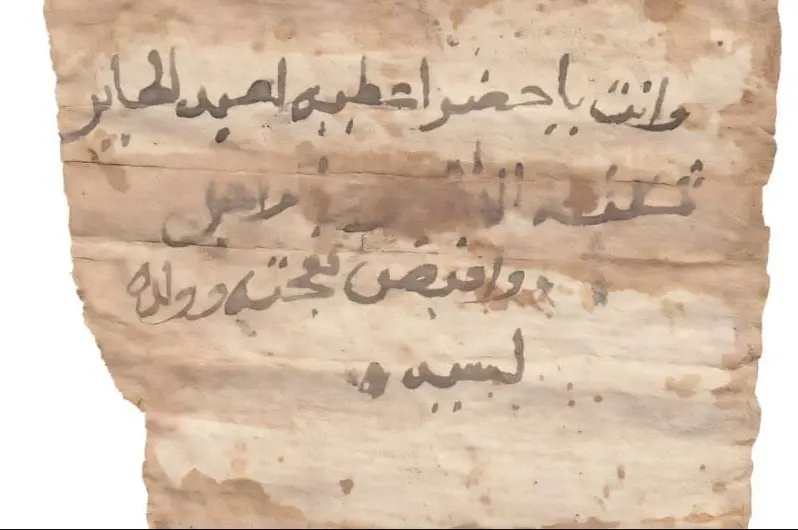
In a pile of trash in Old Dongola, archaeologists found a discarded letter that proves the existence of a semi-legendary king. The 17th-century document is now rewriting what we know about the transition from Christian to Islamic rule in Sudan
An ancient paper found in a pile of trash in the city of Old Dongola, Sudan, has allowed researchers to trace a thread confirming the existence of one of the most enigmatic figures in Sudanese history: King Qashqash. Long, believed to be a semi-legendary figure known only through oral tradition, this document reveals his presence in governance and daily life. It also opens a window onto the relationship between Nubian rulers and the introduction of Arabic into the royal court during the 16th and 17th centuries, even as Nubian languages continued to be spoken among the population.
Bab Masr explores this research paper. To provide a deeper understanding of the document and how archaeologists discovered it, we spoke with Dr Tomasz Barański, a researcher at the Polish Centre of Mediterranean Archaeology, University of Warsaw, and the lead author of the study. He helped explain the city’s history and its transformations through this document, and what it reveals about the entry of Arabic into the circles of power.
A Document in the Name of King Qashqash
The recently published research paper centres on an Arabic document discovered in a pile of trash within an elite residence. It was issued in the name of King Qashqash. Its significance lies in the fact that this king was previously believed to be a semi-legendary figure known only through oral tradition.
The document contains an order for the exchange of textiles and livestock. To analyse it precisely, researchers combined philological analysis, radiocarbon dating, and written sources.
Summary of the Study
The study is titled “A Nubian King at Work: Archaeological Context and Textual Edition of a 16th–17th Century Arabic Document from Old Dongola.” The document, a “royal order” in the name of King Qashqash, reveals his actual existence, his social interactions, the nature of his rule, and his influence on the Arabization of Dongola during the Funj period. Before this discovery, he had been regarded as a semi-legendary figure.
The research, published in the journal Azania: Archaeological Research in Africa, is among the first results of research conducted on Arabic documents discovered in Old Dongola. These are being studied by Tomasz Barański, a specialist in Arabic studies at the Centre for Historical Studies at the University of Washington.
According to the official website of the Polish Centre of Mediterranean Archaeology, the study confirms the king’s existence and reveals the nature of social and economic relations in the Kingdom of Dongola, as well as the relationship between the king and his subjects. The most notable discovery is that Arabic, in a colloquial form, was already in use by scribes serving the successors of the Makurian kingdom in the early 16th and 17th centuries.
The Ruler of Dongola
The research explores new historical evidence indicating that King Qashqash was an actual ruler of the city of Dongola, the former capital of the Christian Makurian kingdom, during the period of Islam’s entry into Sudan. The historic city of Dongola lies on the banks of the Nile and was widely known for its wheat and cotton cultivation, as well as being the capital of the ancient Nubian kingdom of Makuria.
Through this document, researchers have been able to reconstruct many aspects of life in Sudan during one of the least documented periods of its history: the era between the collapse of medieval Nubia (14th–15th centuries) and the Turco-Egyptian invasion of Sudan (1820–1821). This period was marked by the rapid spread of Arabic and the expansion of Islam.
According to the study, researchers avoided rigid classifications such as “Christian” or “Islamic,” noting that the transition from one dominant religion to another took several centuries and involved the coexistence of followers of both faiths.
The King’s House
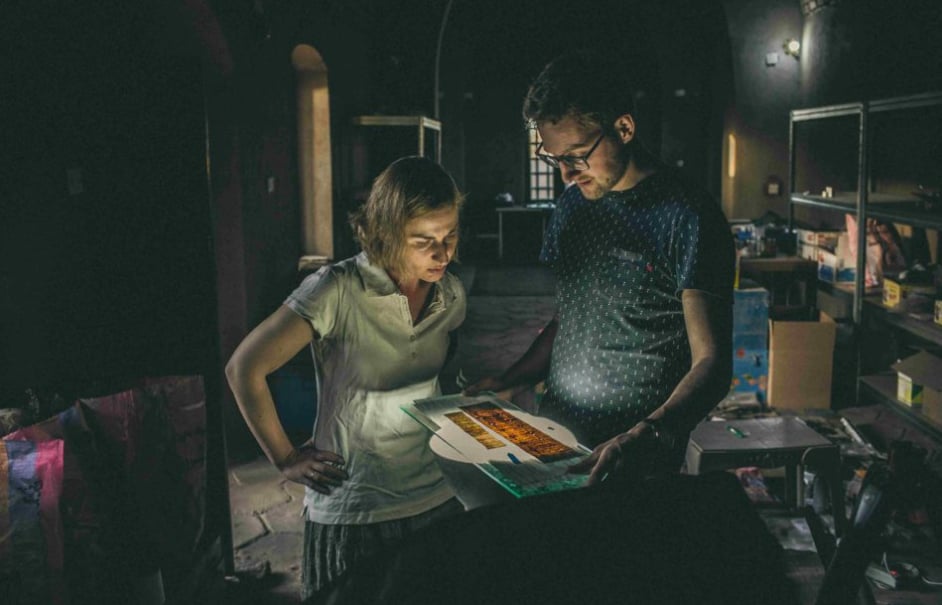
The manuscript, written on paper, has survived in remarkably good condition. The researcher notes that “its language and the scribe’s handwriting indicate a somewhat unpolished level of copying, which is not surprising in an environment where Arabic was not the native tongue.”
Its irregular form suggests it may have been a draft of the original document. It was found in a large residential building, along with over twenty other Arabic documents and other artefacts indicating the grandeur of the place, including cotton, linen, and silk textiles, as well as items made of ivory and rhinoceros horn. Significantly, residents still refer to this building as the “King’s House.”
The Discovery of King Qashqash’s Letter
Dr. Tomasz Barański spoke about the circumstances of the discovery. He recounted the story of finding this Arabic document in Old Dongola in his first Arabic-language statement to “Bab Misr.”
“The document was discovered during archaeological excavations conducted by the Polish Centre of Mediterranean Archaeology, University of Warsaw, as part of the UMMA ERC project led by Professor Artur Obłuski,” he said.
The project aims to study the transformation of a major medieval urban centre—the capital of Christian Makuria—into an Islamic city in later periods, before it gradually declined. He added that the document was found specifically in the ruins of an elite residence, still known among local tribes as the “King’s House.”
The Arabization of Dongola and Protective Amulets
What has changed in our understanding of Dongola’s history following the confirmation of King Qashqash’s existence? And what does it signify that the document’s scribe was not proficient in classical Arabic?
Barański explained: “The king’s order is one of approximately fifty Arabic documents written on paper discovered during excavations in Old Dongola.”
He is currently preparing the scholarly edition of this collection, which includes private letters, legal and administrative documents, as well as written amulets known as hijab, used for protection against evil.
He emphasised that Qashqash’s letter does not change what is recorded in historical chronicles so much as it provides tangible physical evidence of the existence of a ruler previously known only through oral tradition. This necessitates a re-reading of this obscure period of Sudanese history.
The Identity of the Sudanese People
Can this document be considered evidence that Arabic became the language of administration in the royal court?
Dr Tomasz explained: “The study of the Arabization and Islamization of Nubia is a broad topic that deserves significant attention. It is crucial for understanding the complex identity of the Sudanese people, not only in the past but also in the present.”
This document confirms the use of Arabic in royal administration during the 17th century. “But there is no doubt that Nubian languages remained the most widespread in the Nile Valley for a long time, even after the Turco-Egyptian conquest of Sudan,” he told Bab Masr.
The Dark Ages of Dongola
The study refers to what is known as the “Dark Ages” in the history of Dongola, a period about which little is known. Tomasz explained that the post-medieval period,the era between the disintegration of the Makurian kingdom in the 14th century and the establishment of the Funj Sultanate in the 16th century, is poorly documented in historical records.
This period, which followed the decline of the Christian Nubian kingdoms, is characterised by a marked decrease in the volume of written records. Hence, it has been called “dark” due to the scarcity of historical sources, relying primarily on oral tradition, unlike earlier periods that left behind more abundant documentation.
This era is sometimes referred to as the “Dark Ages” in Sudanese history, similar to what occurred in Europe during the Early Middle Ages, which also suffered from a relative lack of historical evidence following the fall of the Roman Empire.
He added to Bab Masr, “Thanks to archaeological excavations and subsequent research, we are now able to recover more details of Dongola’s history during that period. Not only about its rulers and elites but also about its inhabitants, their diet, customs, and, to some extent, their identity and mindset.”
The Dark Ages
According to the research, by the mid-14th century, the city of Dongola entered what is known as the “Dark Ages” of Sudanese history. It ceased to be the capital of the Makurian kingdom, and little is known about the following three centuries. Over millennia, Nubia had been a vital hub for the movement of people, goods, and ideas. Goods such as gold, ivory, and slaves passed through it, and it actively shaped these flows.
Barański explained that this transformation was not sudden. Nubia was not a marginal or isolated region of the Nile Valley but rather an important corridor connecting the Mediterranean world with sub-Saharan Africa.
The study references the Tabaqat (Book of the Classes), a 19th-century biographical dictionary compiled from oral traditions about Sudanese religious figures. It notes that “the city gradually shrank, leaving only the central citadel and its surroundings. There are references to the city and its rulers, including a man named Qashqash, said to be the great-grandfather of Sheikh Al-Hilali, son of Muhammad ibn Isa Suwar al-Dhahab, one of the most important religious figures in Sudan to this day.”
From King Qashqash to Al-Khidr
In 2018, the project “Urban Metamorphosis of a Medieval African Capital” (UMMA) began a new phase in studying the history of Dongola, focusing on exploring its political and urban past, particularly the citadel area and its surroundings.
During excavations, researchers studied the building designated as “A.1,” which oral tradition identifies as the residence of Dongola’s kings. Excavations revealed a collection of artifacts associated with the lives of the ruling elite, including luxurious cotton, linen, and silk textiles, leather shoes, ivory pieces, a dagger handle made of rhinoceros horn, and a gold ring.
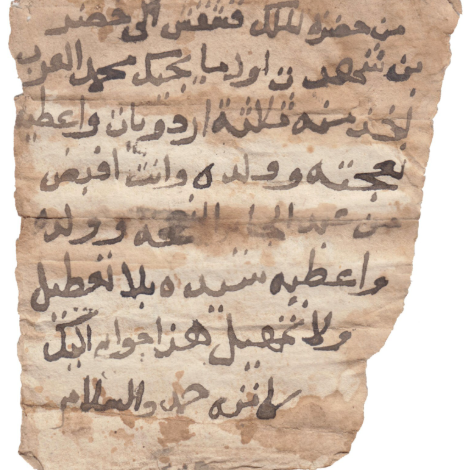
Researchers also discovered over 23 new Arabic texts. Among them was a document found in a pile of trash containing an order issued by King Qashqash.
The Text of the Letter
“From King Qashqash to Al-Khidr bin Shahd: As soon as Muhammad Al-Arab arrives to you, take three garments from him and give him a ewe and her offspring. Collect the ewe and her offspring from Abdel-Jabir and return them to their owner without delay. Do not hesitate to carry this out. This is my message to you, written by his scribe Hamad. Peace.”
The letter continues with further instructions:
“And you, O Khidr, give Abdel-Jabir three pieces of cotton fabric and a head covering, or three cotton head coverings. And collect the ewe and her offspring to be returned to their owner.”
Colloquial Arabic in the Royal Court
The document confirms the existence of Qashqash, previously regarded as a semi-legendary figure. It provides evidence that he was one of the earliest known rulers of Dongola in the post-medieval period. Analysis of the text reveals important linguistic features. The scribe was not proficient in classical Arabic. He used possessive pronouns without distinguishing number and gender, and the writing is abbreviated and leans toward a colloquial style.
These characteristics show how Arabic was beginning to become the primary written language in the royal court, even though it had not yet become the city’s official language.
Researchers based their analysis on several sources for comparison, including the Qasr Ibrim documents, the Tabaqat by Muhammad Nur ibn Dayf Allah about saints, righteous figures, scholars, and poets in Sudan, and foreign accounts such as the writings of Krump and Poncet around 1700.
In contrast, Leo Africanus’s observation that “the king of Nubia was always at war” stands in contrast to the content of this document, which reveals a ruler concerned with internal affairs and daily transactions. This offers a new perspective on the social and political history of Dongola and confirms its importance at the crossroads of Ottoman Egypt.
