


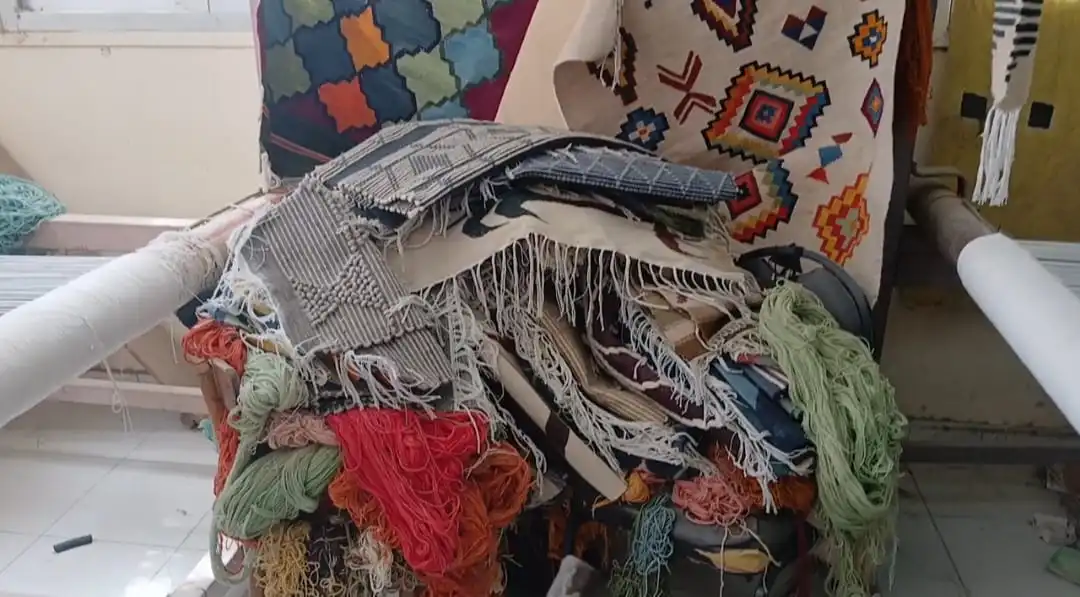
A rhythmic journey through the narrow arteries of Fuwa, where the scent of the Nile meets the ancient clatter of the loom, this article chronicles the struggle to sustain Egypt’s hallowed tapestry traditions. As master artisans translate global masterpieces into wool, they face a silent crisis of economic stagnation and the looming threat of cultural extinction.
By Mahmoud Dueir
When one wanders through the city of Fuwa in the Kafr El-Sheikh Governorate, the scent of the Nile mingles with the earthy aroma of yarn and raw fabrics. The air is thick with the legacy of ancient dye-houses, punctuated by the rhythmic clatter of looms and the shared laughter of artisans. Fuwa’s narrow arteries lead the traveller into a mystical realm where the river’s serenity reflects a deep well of history and creative brilliance. Here, a relentless industry thrives, practised by masters whose work represents the zenith of artistic precision. Yet, beneath their cheerful countenances lies a fragile hope: that their craft the very anchor of their identity and the protector of the nation’s cultural soul will survive to see a more prosperous dawn.
This venerable profession currently teeters on the brink of extinction, besieged by anaemic marketing and a decline in official patronage, threatening to bury one of Egypt’s most vital cultural pillars under the dust of neglect.
Canvases for the World’s Masters
“I have carried this craft for 14 years, a legacy inherited from my father and grandfather,” explains El-Sayed El-Mazaty, a specialist in weaving and Gobelin (tapestry-style wall hangings). “I mastered it step by step until the loom became an extension of myself. The genesis of every piece is raw wool, spun into yarn and then christened with color in specialized masabigh (traditional dye-houses).”
Discussing the taxonomy of handmade carpets, El-Mazaty notes that they range from the understated beauty of plain weaves to the intricate Mustashriqeen (Orientalist) style. The latter are textile translations of masterpieces by global and Egyptian painters. Every line is meticulously plotted with pen and ruler upon the loom before the threads are woven to mirror the original soul of the painting.
Pricing reflects this labor of love: a square meter of a plain weave commands between 200 and 300 EGP. In contrast, a meter of the prestigious Mustashriqeen often referred to as Wissa work can reach 3,000 EGP.
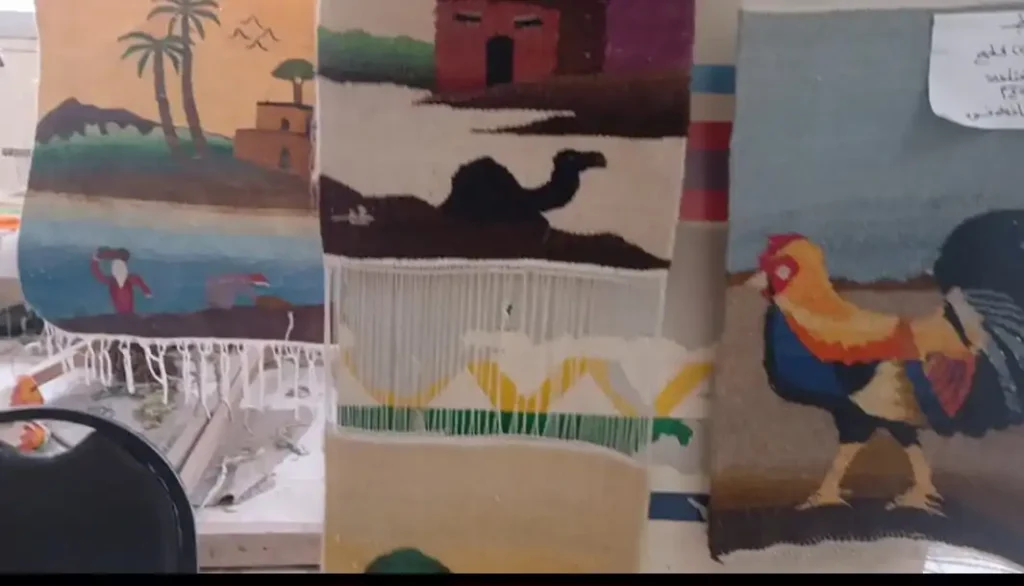
Aziz Darbala, another veteran of the loom, laments that the craft Fuwa has championed for millennia is now haunted by the specter of vanishing. Marketing, he insists, is the lifeblood of their continuity. He points to a grim reality: most artisans have ceased passing the trade to their children, deterred by a biting stagnation. Numerous workshops have already shuttered their doors, unable to weather the financial losses. Darbala believes the antidote lies in tourism integrating Fuwa’s textile treasures into the traveler’s map. It pains him that Fuwa, a city of artisanal gold, remains overshadowed by regions like Harraniya or Saqiyat Abu Shaara, which enjoy robust promotional support while Fuwa languishes without official backing.
Darbala further observes that even when tourists do arrive, they are often funneled toward archaeological sites, bypassed by the living history of the weaving workshops. Participation in international exhibitions remains a distant dream for many, stifled by the exorbitant costs of floor space. He calls upon the Governorate and the Ministries of Culture and Tourism to intervene, noting that a craftsman’s daily pittance rarely exceeds 300 EGP.
Amidst the hum of the workshops, Yasser, a specialist in Tabkeer (the process of winding yarn from hanks onto bobbins), moves with the practiced ease of someone who has spent half a century in the trade. Like so many here, his hands follow a path blazed by his ancestors, serving the constant demands of the master weavers.
Distinguishing the Kilims from the Carpets
Adel Sabawy, 67, has been immersed in the world of threads since the age of five. He clarifies a common distinction: the Kilim (flat-woven tapestry) is crafted from pure, unadulterated wool. This purity grants it a value and price point far exceeding standard carpets, which often incorporate mixed fibers.
Sabawy, too, has broken the chain of inheritance, refusing to lead his children into a profession paralyzed by a lack of demand. He warns of a day when the craft might vanish entirely. “Fath Street used to pulse with the sounds of the Sana’iya (skilled artisans); it was a symphony that never ended,” he recalls. “Now, silence has claimed most of those workshops.”
“We are the ones who taught the art of the handmade Kilim to the rest of Egypt,” he continues with quiet pride. “The product of Fuwa is distinguished by a mastery passed through bloodlines.” Mounir, a fellow weaver, echoes this sentiment, citing a dire shortage in the supply chain as another nail in the coffin of their trade.
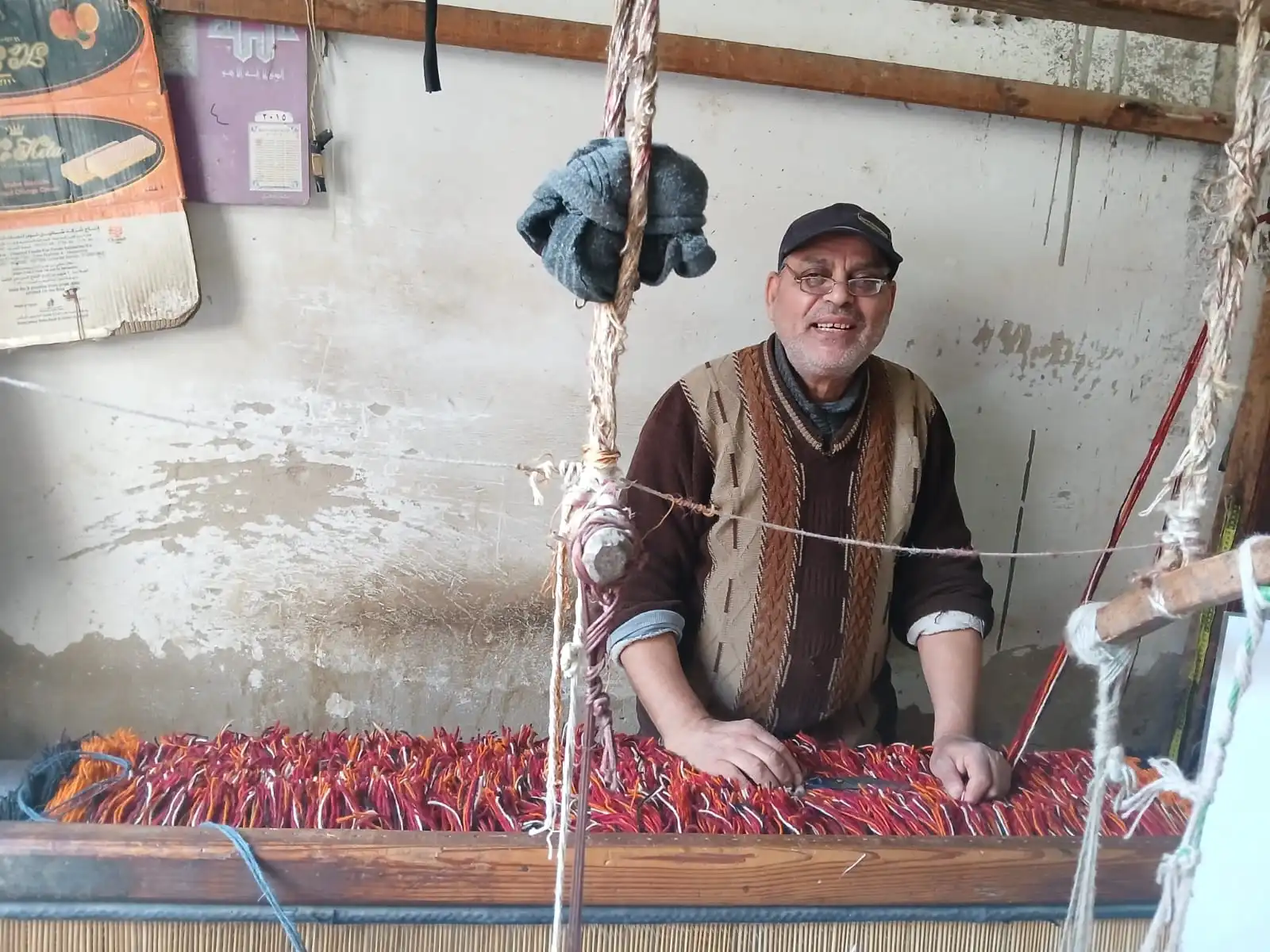
In a bid to preserve Fuwa’s singular cultural fingerprint, an Environmental Crafts Unit was established within the Fuwa Cultural Center to apprentice the youth in the weaver’s art.
Mohamed El-Gharbawy, Director of the Fuwa Cultural Center, explains that the unit, founded in 2005, has recently undergone a revival. Following the retirement of the original staff, the center has recruited young artisans on a contractual basis. The program seeks to bridge the gap for local youth and technical students, offering a curriculum that marries historical theory with the tactile reality of the loom.
The mission is to root this industry in the consciousness of the new generation, free of charge. The center collaborates with Kafr El-Sheikh University and the Faculty of Specific Education, inviting fine arts professors to curate exhibitions. El-Gharbawy notes that while these pieces are sold through the Ministry of Culture’s outlets—often at prices more accessible than the private sector the master trainers remain on a precarious daily-wage system, many dreaming of the support needed to launch their own independent ateliers.
The Exodus of the Masters
Dr. Jacqueline Bishri, a professor at the Faculty of Fine Arts at Minia University and former director of the Kafr El-Sheikh cultural branch, was instrumental in reviving the Environmental Crafts Unit in 2019. While she successfully brought young artisans back to the looms, she expresses deep concern over their unstable contractual status. Her hope is for their permanent instatement within the Ministry of Culture to ensure the unit’s longevity.
Dr. Bishri identifies the core crisis as a failure of commerce. She categorizes Fuwa’s output into three distinct tiers: the traditional Kilim; the Gobelin, which thrives on spontaneous, intuitive design; and the Mustashriqeen, which interprets the works of celebrated Arab and international artists. There is also the Qasaqis (rag-rug) work, a more utilitarian, market-driven product.
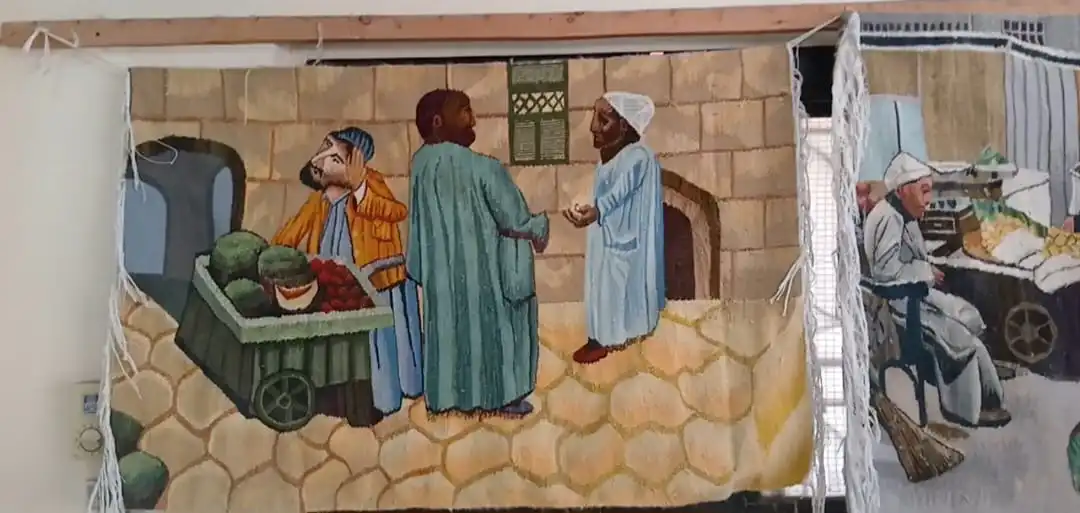
“Fuwa taught Egypt this craft,” Dr. Bishri said, “yet it is the village of Harraniya that has flourished by maintaining premium material standards and sophisticated design, bolstered by the legacy of architect Wissa Wassef.” She warns that despite the abundance of talent in Fuwa, the exodus of artisans is real. Many have abandoned the loom for more lucrative labor; today, only a single dye-house remains functional in the entire city.
Through the Supreme Council of Culture, Dr Bishri has repeatedly advocated for a state-led marketing offensive, though her pleas have yet to find fruit. She calls for “urgent safeguarding” of the Gobelin and Kilim industries, emphasizing that such an intervention is not merely economic it is a preservation of a rare and hallowed heritage.
Her mandate for the future is clear: tax exemptions for artisans and robust marketing infrastructure to protect Egypt’s cultural identity. In a final nod to the city’s artistic synergy, she highlights the collaboration between the unit and local luminaries, such as Dr. Abdel Wahab Mohsen, whose visual visions have been immortalised in thread by the master weavers of Fuwa.
