


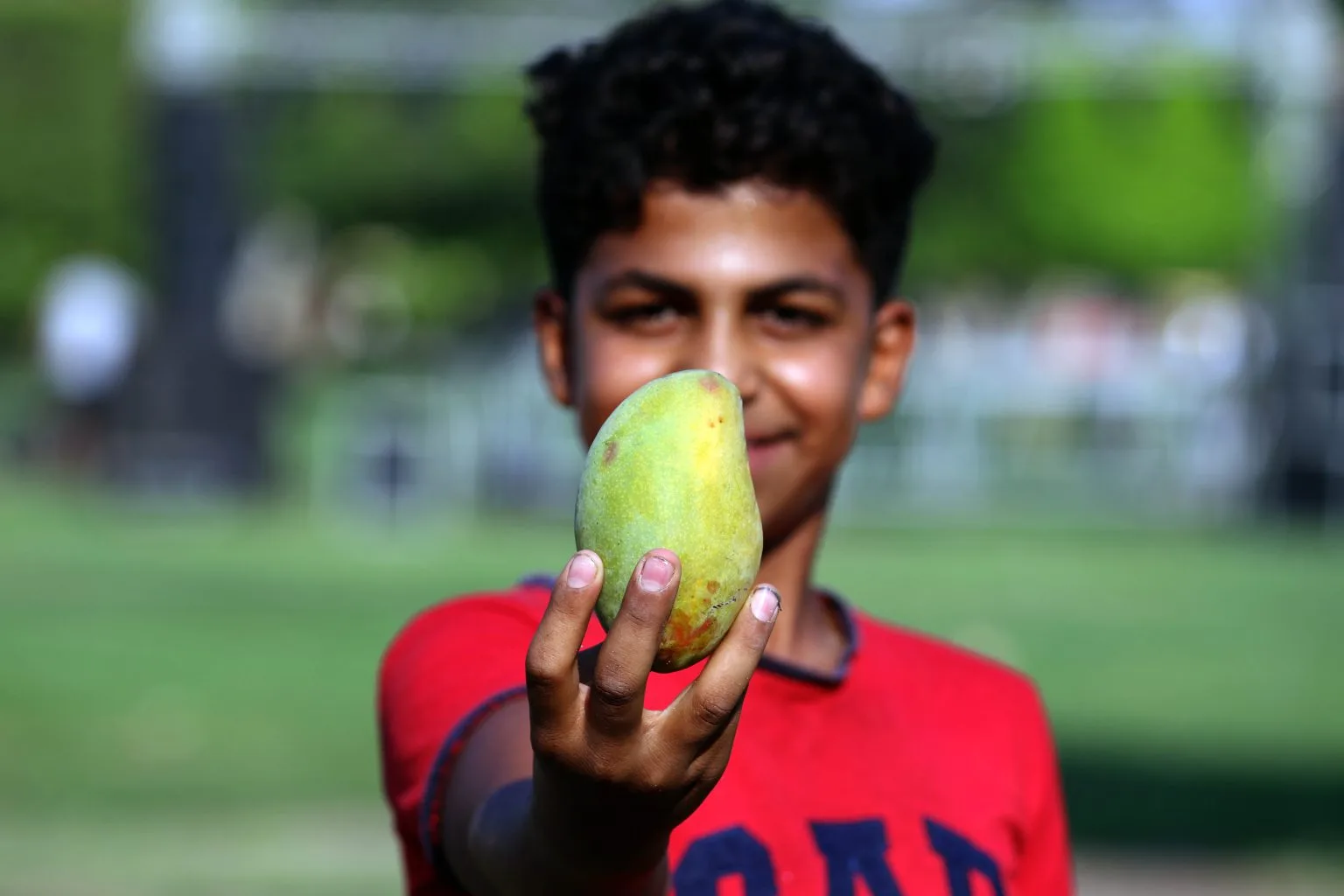
On an open stage in a public park, the Ismailia and Sharqia folk art troupes performed songs that blended tradition and modernity, as many did at the recent Mango Festival, where they sang about the fruit and enumerated its virtues as if it were a beloved admiring its beauty to the strains of the simsimiyya and rababa.
The song “Azima Ya Manga” is famous, sung by many singers, starting with Al-Reis Metqal with a Saidi mawal on the rababa, and Abdu Al-Othmani in the role of Damma Simsimiyya in Ismailia, to Muhammad Rushdi when he flirts with his beloved with the words of the poet Abdel Rahman Al-Abnudi: “Ah, O night, O moon…” Manga is sweet as sugar,“ and even Tawfiq, the ice cream seller in the operetta ”Al-Dandorma.”
At the Mango Festival in Ismailia in early August, the song “Ahla Manga” was presented as the official song of the festival, with lyrics by Mohamed Maghawri and sung by Rafiq Youssef, listing the types of mangoes known in the city and the ways of eating them, whether as food or juice.
What is the origin of mangoes?
Mangoes originated in Asia and arrived in Egypt in the 19th century. They then began to gain a place in popular heritage, in poetry and songs. Dr. Hamdi Suleiman, professor of sociology at the Faculty of Education, University of Al-Arish, explains this by saying: The culture of the people of Ismailia is shaped by a variety of factors. The most important of these are geography, the Suez Canal, the arts of simsimiyya, and a history of resistance that continues to inspire successive generations. In addition to a strong passion for football and the Ismailia team, “Al-Darawish.” There is also the Sahlia fish and mango fruit, the latter of which holds a special place in the hearts of the city’s residents and fans in Egypt and the Arab world.”
He adds: “Mangoes are present in many aspects of the city, in its farms, home gardens, and historic villas scattered throughout the Afrang area. The love for mangoes has permeated many aspects of life in this city. Starting with its distinctive yellow color, which symbolizes the sun and hope, and forms the cultural identity of the city. It is famous for the color of the historic Ismaili team’s shirt, and it is also the distinctive color of taxis. In addition, it is widespread in sidewalk paint and the facades of some shops and kiosks.”
He also points to the way the people of Ismailia express their love for mangoes in their poetry, songs, decorations, paintings, and various arts. Mangoes are also a beloved gift that the city’s residents send to their relatives and friends who live outside Ismailia.
Mangoes in Indian and Egyptian culture
In India, where mangoes were first cultivated as a tropical fruit and from where they reached Egypt, mangoes have been associated with love, fertility, and romance in Indian literature for centuries. They appear as a metaphor for the beloved, with the sweetness of the fruit representing the sweetness of love, such as in the poem by Indian poet Amar Kagal, when he compares his beloved’s eyes to ripe mangoes.
Dr. Hamdi Suleiman says that mangoes also appeared in zajal poetry in the 1980s, as zajal is closer to lyrical poetry and can be turned into songs that are more popular than poetry. The mango was represented as a beloved in a song by Mohamed Rushdi, when he describes the beauty of his beloved as a mango ripening on the tree. More recently, the singer Asala described her lover as “the jewel of fruits, oh mango” and insists that he love her.
In the early 1980s, Laila Nazmi sang about mangoes and strawberries in her famous song “Al-Dunya Har” (The World is Free), saying:
The world is free, the world is free, I want to go out and have fun, where can I go?
I want mangoes, I want strawberries, I want to drink something sweet, where can I find it?
The fruit seller, the confectioner, and the juice shop have opened for me
In front of him is a garden and shade, I walk with my brother, I drink and bring you a cup
***
In colloquial poetry, Saleh Jahin presented his quarrel between the mango and the grape:
The mango said to the grape, “Come here, you excessive one.
You are ripe and you have a price. What are you complaining about?”
The grape was upset with her and went to complain to the banana.
He said, “Is that okay? Or even permissible?”
Is it a bowl? Is that how you do it?
When did ‘Azima Ya Manga’ start?
Mohamed Mida, a simsimiyya player in Ismailia, says: “The song ‘Azima Ya Manga’ is part of Ismailia’s heritage. The city is famous for simsimiyya and mangoes.”
He recalls that the first person to sing it was the singer and musician Abdo Al-Othmeli. He said, “The song is associated with a fruit that is famous in Ismailia, and it is well known that Al-Reis sang about strawberries on the rababa. Also, mangoes are not as famous in Upper Egypt as they are in Ismailia.”
Mida explains the lack of new songs about mangoes to be sung on the simsimiyya by saying: “There are things that are like fingerprints; they cannot be repeated or imitated. One of them is ‘Azima Ya Manga’; no one can imitate it, just like no one can imitate Al-Mashrati like Sayed Makawi and Al-Layla Al-Kubra.”
Hajazi Metgal
Two years ago, the popular singer Hijazi Metgal released a video clip for the song “Great Manga.” He attributed the lyrics and melody to his late father, Al-Reis Metgal. Metgal Qanawi is famous for his heavy Upper Egyptian dialect in the 1975 song “The Strawberries Are Strawberries, Come Buy Them From Me First.”
Ahmed Farouk, a senior broadcaster at Al-Qanah Radio, recalls that the song “Azima Ya Manga” was first broadcast with Al-Reis Metqal’s voice on the rababa. It then spread as folk heritage to the simsimiyya song and became famous here. This is because the simsimiyya song has a more joyful sound and is more closely associated with the city. He says, “The simsimiyya is connected to the hearts of its fans in Ismailia. It tells the story of their day and repeats songs that are close to the same musical scale. So people here remember the song ”Al-Farawla Bat’a Al-Farawla“ by Metqal, ”Azima Ya Manga” by the simsimiyya heritage.
The eloquence of vendors’ calls
In his book People in the Shadows, published by the General Book Authority in 1984, writer Yahya Haqqi distinguishes between the calls of vegetables in the markets, such as tomatoes, eggplants, and jujubes. He sees these calls as spontaneous folk poetry.
As for the newer calls for guava, mango, and strawberries, they have not found the unknown genius composer who will immortalize them. The calls for these fruits are more like a page written in a report style, in the middle of a book that sparkles with an attractive artistic style reminiscent of poetry.
