


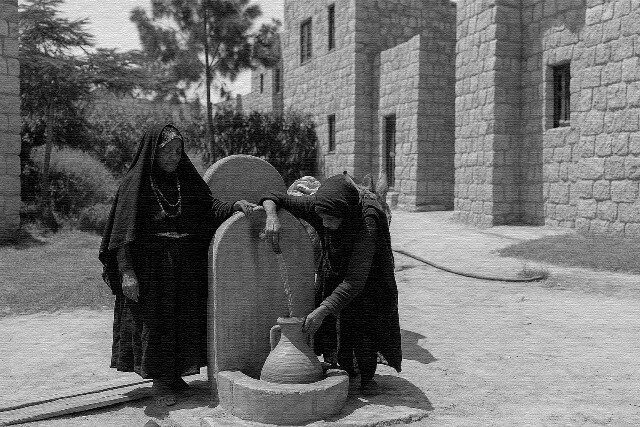
Like border towns and desert cities, where humans are constantly battling nature to create an environment suitable for survival, Safaga has been and continues to be the scene of this eternal struggle. Among its mountains, life sprouts from cracks, clings to hillsides, and blooms even in the depths of the valley, searching for any means of survival despite the harsh scarcity of water and, at times, its complete absence. Nevertheless, the people who have inhabited this land for hundreds of years did not give up. Instead, they undertook arduous journeys in search of sources of drinkable water, until their attempts became tales to be told, immortal stories that bear witness to human resilience in the face of the harshness of the desert.
The beginning of the story
Mohammed Khairi, a 70-year-old resident of Safaga, says: “The story began when the Arabs set foot on the land of Safaga, bringing with them the fragrance of the desert and the scent of the sea from their hunting trips stretching from the Arabian Peninsula and Yemen. They made this spot their home, living off herding and hunting, and roamed the valleys and mountains in search of water to quench their thirst and give them a reason to survive.“
He continues: ”They settled in the valleys and in the south of Safaga, leaving their mark on the place. Both Wadi Al-Arab and Wadi Qatil bear witness to man’s struggle with the harshness of nature and his desire to survive. From there, the lineage of these pioneers, extending from the roots of the Arabian Peninsula, continued. It bore fruit in ancient families such as the Abdoun and Hamza al-Qadi families, who are still bound by blood and marriage to their relatives on the peninsula, who have never lost their sense of longing.
Ain al-Magla: the source of life in the heart of the desert
Despite the harshness of the desert and the mountains that seem like towering fortresses defying the wind, Othman Fathi, a native of the village of Umm al-Huwaitat, points out that the Arabs and the first families in Safaga found nothing to help them survive except the water from wells and springs. These springs were far apart, separated by distances that could take days or even weeks to travel. As the primary source of life, they provided water for humans and animals and gave people the patience to live despite the harshness of nature. Families formed around them, and small communities sprang up, which later became the city of Safaga.
Fathy adds: “Between the endless sands and rugged mountains, near the ancient village of Umm al-Huwaitat on the shores of the Red Sea. Sixteen kilometers away, and a few dozen kilometers from Safaga, lies one of nature’s treasures, Ain al-Magla. Its pure water springs from the heart of the rocks, five meters above the ground. Clear as if it had just come out of a spring in paradise, it quenches the thirsty, gives caravans new life, and camels and goats drink from its waters. Migratory birds also stop there to rest from their long journey.”
Khalid Ramadan, a tour guide, says: “Because of the purity of its water, the locals named it ‘Ain al-Magla’ (the spring of the mirror), and it became a destination for excursions and tourists. Safari caravans set out from hotels in Safaga to enjoy the magic of nature and the wonder of the place. It is not just a spring, but a witness to the story of survival in the middle of the desert.
The waters of Aden… A distant gift from the sea
Another story reveals another side of the struggle for survival, says engineer Ali Ghazali Al-Shawari, who is interested in the heritage of Safaga: “When oil companies began flocking to the shores of the Red Sea in search of minerals and energy resources, their ships filled the ports between Garib and Safaga. These ships used to go to the refineries in Aden in southern Yemen, and on their return they would carry on board what is known as ballast water, which serves to maintain the ship’s balance as it sails.
This water was not completely pure. It was sometimes mixed with traces of fuel and petroleum, but it was nevertheless welcomed in Safaga as if it were the first sign of rain after a long drought. The locals would cheer with joy when it arrived, until “Aden water” became a lasting memory in the hearts of its people. It became a symbol of their long patience with the harshness of the desert and its scarcity of resources.
The Kandaasa: The Water Machine and the Iron Miracle
Mohammed Saeed Mustafa, a senior teacher and poet, tells a different story about water that is linked to the city’s memory during the British colonial era. In 1907, the British built the first seawater desalination plant in Safaga. It was coal-fired and relied on a technology that heated seawater, converted it into steam, and then condensed it into fresh, drinkable water. The locals named this machine “Al-Kandasa,” taken from the Latin word “condensate,” meaning condensation, and it became an early symbol of modern desalination plants.
He adds: “Al-Kandasa” was not just a machine, but rather an iron creature that breathed steam and groaned hoarsely whenever the workers turned its switches. Until it overflowed with fresh water, as if it were a spirit that gave life to a thirsty city. This machine was associated with the phosphate company, as it was the artery that quenched the thirst of workers and employees. It provided them with self-sufficiency in drinking water.
Mustafa points out that the people of Safaga impressed everyone with their skill and determination, as they reactivated the “Kandasa” with their own hands and made its spare parts after the manufacturing company stopped providing technical support. The “kandasa” continued to be maintained and repaired until 1967, when it breathed its last breath and stopped working for good. However, it remained in the memory of Safaga as a spirit of steam and iron that wove a part of the legend of thirst and quenching.
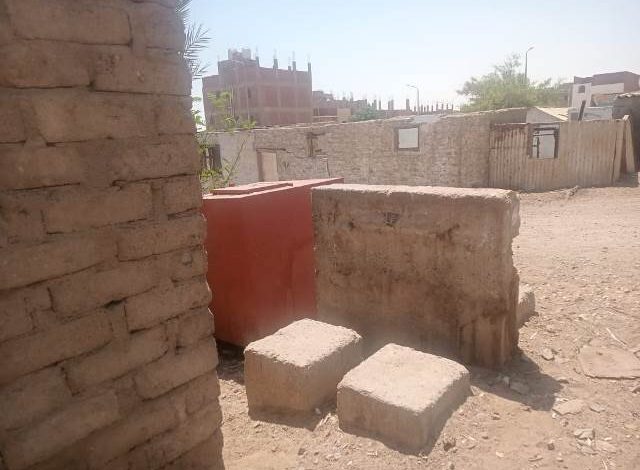
The drinking fountains… the first civilizational spring to flow in Safaga
Engineer Adel Ghazali recounts that the first rain did not fall on Safaga from the sky alone, but rather in 1970 by decision of General Saad El-Din El-Shazly, then commander of the Southern Military Region. He ordered a water line to be laid from Qena to Safaga via iron pipes. This event was a qualitative shift that reshaped the daily lives of the city’s residents, especially the loading and unloading workers, who suffered most from the scarcity of water.
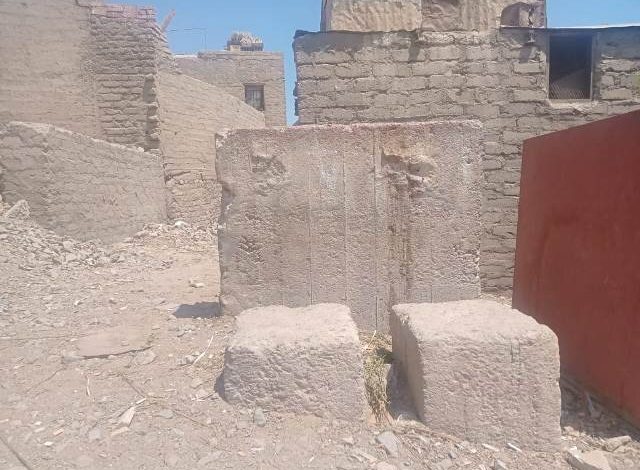
Ghazali adds: One of the fruits of this project was the creation of five drinking fountains. A drinking fountain is a concrete structure raised a meter or so above the ground. It is surrounded by stone benches and has four taps from which water flows. The five drinking fountains were erected in the heart of the most densely populated neighborhoods, four of them in the Safaga Balad area and the fifth in the military works area.
Ghazali continues: The mashrabiyas were not just water fountains, but also small theaters where daily stories intersected. Women would gather to fill their tin cans and clay jars with water, their voices, sometimes reduced to whispers, mingling with the sound of water flowing from the fountains, while their children played nearby. When the women were absent, the benches surrounding the mashrabiya became places where passersby could sit and catch their breath after a long walk.
Thus, through these mashrabiya, the first drops of water entered Safaga through the pipes. It became a symbol of urbanization and the beginning of a new chapter in the history of a city that had long endured thirst.
Ground reservoirs… memories of thirst and quenching
The search for water has not ended, no matter how much the means and times have changed. Mohsen Hamdallah, a native of Safaga, says: “With the increase in population density, the city returned to relying on underground reservoirs. A huge reservoir with a capacity of between 20 and 30 tons was built in each area, filled with clean water coming from Qena.”
He adds: “The scene was reminiscent of what used to happen in the old days when bread and flour were distributed. People would stand in long lines under the scorching sun, waiting for a container of water with a capacity of no more than 20 liters. And if the supply was low, they might only get half of that. That is why families were not allowed to move to the city due to the water shortage. The raising of birds and animals was also prohibited. If anyone was caught violating these instructions or warnings, their family would be deported.
He pointed out that during the British occupation, each family’s share of water was a quarter of a can. After the British left, it became a full can, and then two cans for families with children. Bathing and ablution were done by wiping the body with water.
The scene repeats itself, and thirst remains a hidden companion that never leaves the people of Safaga, sharing the details of their day as an inevitable fate. From the heart of this deep-rooted thirst, the dream of expanding and increasing the number of desalination plants continued to be renewed. Or that the amount of water coming from Qena Governorate would double. To quench the city’s thirst and end a long chapter of struggle with water scarcity. A dream resembling salvation. The salvation of a city that has been waiting for a long time to drink as other cities drink.