


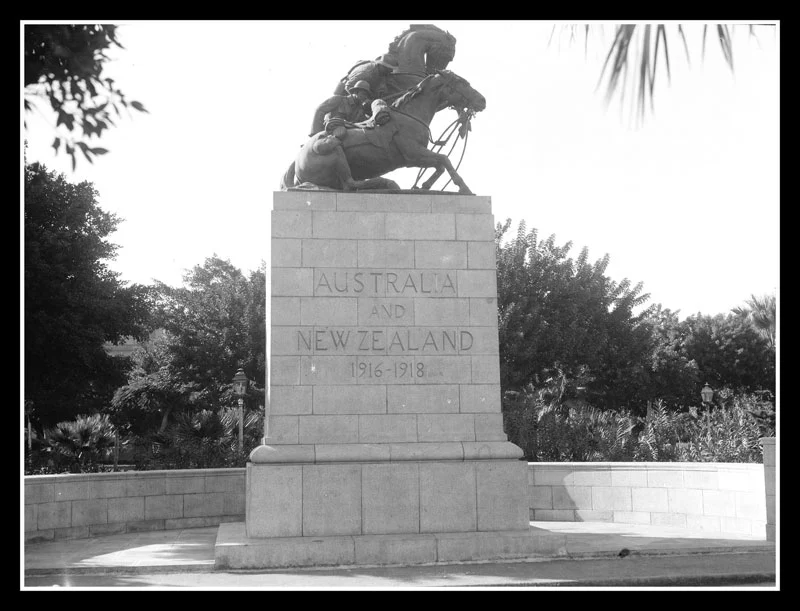
In 1932, a striking bronze statue was unveiled in Port Said, honouring fallen Australian and New Zealand soldiers. Twenty-four years later, it was destroyed by a mob during the Suez Crisis. Today, two copies stand in Australia. This is its remarkable story
By Osama Kamal
In only a few cities can a statue become a story, can stone become memory walking between nations. Port Said, a city accustomed to standing at history’s crossroads, once hosted such a statue. It stood in a garden overlooking the canal, carrying in its silence a tale that stretches between two shores of the world.
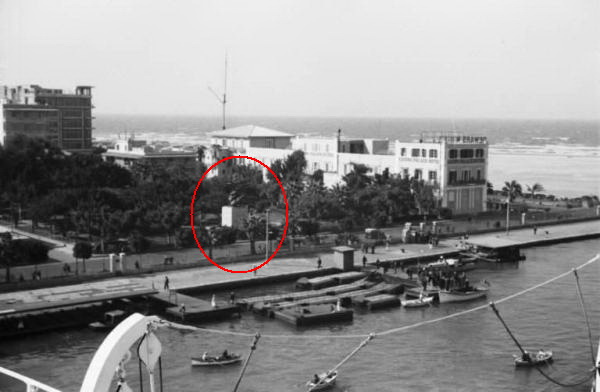
This was the ANZAC Memorial, known simply to the people of Port Said as the “Unknown Soldier” statue. For years, it stood in the middle of the Casino Palace garden, looking out over Sultan Hussein Street (now Palestine Street), directly facing the Suez Canal. As if watching the ships pass between continents. As if waiting for comrades who would never return.
Casino Palace: A City’s Memory
The story did not begin with the statue, but with the place that housed it. The Casino Palace Hotel was once one of Port Said’s most famous and glamorous landmarks. It belonged to Silvio Simonini, an Italian pioneer of tourism and hospitality who, in 1923, obtained approval from the Suez Canal Company to build the hotel on land overlooking the sea and the canal.
Simonini constructed stone breakwaters to protect it from the waves, then built a luxurious wooden terrace facing the sea. Later, a glass structure was added, becoming a stage for musical groups arriving from Europe and America. Many orchestras played their most famous pieces during Port Said’s lively nights there, including the Paul Tine Orchestra, which performed on Sunday evenings in 1949.
More Than a Hotel
The Palace was not merely a hotel. It was a social and cultural theater for the city. Kings, princes, and presidents stayed there. Governors held their official receptions in its halls. Port Said’s elite celebrated their weddings in its rooms.
Many figures who left their mark on history passed through its doors. Empress Eugenie returned in 1905 as an ordinary citizen, driven by nostalgia to visit Port Said thirty-five years after attending the Suez Canal’s opening in 1869. The Nile poet Hafez Ibrahim stayed there in 1910 when he came to the city for the opening of the Islamic Charitable Society School, reciting his famous poem “Knowledge and Morals.”
In 1919, nationalist leader Saad Zaghloul stayed at the hotel during his journey into exile on the island of Malta. Over the years, the hotel remained a stop for faces that shaped an era: Mahatma Gandhi passed through, King Farouk stayed there, the footsteps of Umm Kulthum echoed in its halls, and screen stars Omar Sharif and Faten Hamamah knew its corridors.
With time, the hotel appeared in scenes from Egyptian cinema classics such as “Love and Tears” in 1955 and “A Love Rumor” in 1961. The Palace was never just a hotel on the seashore. It was an open ledger recording the faces of politics, art, and thought in an era when Port Said was Egypt’s window onto the world.
A Statue That Told War’s Humanity
Amid all this glamour, a silent statue stood in the garden, carrying a completely different story. It was erected in memory of the Australian and New Zealand soldiers killed in the region during World War I, between 1916 and 1918.
The statue was made of bronze on a granite base. It depicted two cavalrymen, one New Zealander and the other Australian. The New Zealander’s horse had been wounded, and the Australian reached out his hand to support his comrade. A human image of war that celebrated not victory but companionship and survival. Hence its name: the ANZAC Memorial, honoring the Australian and New Zealand Army Corps.
Difficult Birth
The path to creating this statue was not easy. The idea was initially proposed by surviving veterans of World War I. Australian cavalrymen, New Zealand infantry, mounted troops, and war nurses collected 5,400 pounds sterling. The Commonwealth government contributed 11,600 pounds, and the New Zealand government added another sum to cover costs.
In 1923, the Commonwealth government announced a competition for the memorial’s best design. Australian sculptor Web Gilbert won. The New Zealand armed forces sent the artist photographs of real cavalrymen and of the famous mare “Bess” to serve as models for his work.
But Gilbert died before completing the statue. It was said the task’s magnitude exceeded his health. The work was then assigned to English sculptor Paul Montford, who labored steadily. But the project faltered again, eventually passing to Australian sculptor Sir Bertram Mackennal, who completed the statue with his team’s help. He too died before seeing its unveiling. As if this statue’s fate was to be born from the exhaustion of those who made it.
From Celebration to Destruction
On November 23, 1932, the statue was unveiled in Port Said in the presence of Australian wartime Prime Minister W. Hughes. In a unique event, his opening speech was broadcast by telephone to Australia over nearly twenty-four thousand kilometers. It was the first live broadcast between the two countries.
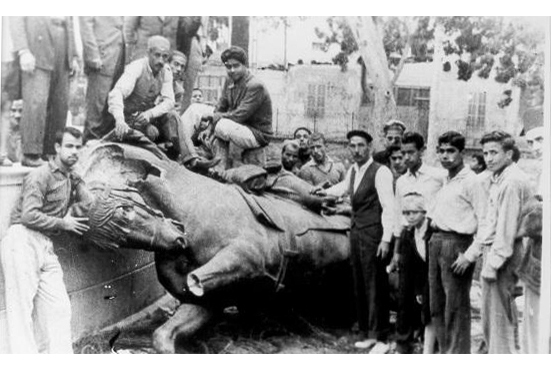
The statue remained standing in the Palace garden until the night of December 26, 1956, during the tripartite aggression against Egypt. A group of local youths attacked it with hammers and stones.
Despite police gathering to prevent its dynamiting, they could not prevent its destruction. It was completely smashed. The Australian cavalryman’s figure vanished, leaving only the granite base as witness to a statue that no longer existed.
Journey to Australia
After the destruction ended, the Australian and New Zealand governments requested the statue’s remains. Egypt agreed and shipped the parts by sea to Australia. Since restoration proved impossible, it was decided to make a new copy. Work was completed in 1964, and it was erected in Albany, Western Australia, at the site where cavalry forces had gathered before heading to war.
On October 11, 1964, the statue was unveiled in the presence of Australian Prime Minister Sir Robert Menzies. Thousands attended, including about one hundred sixty veterans and some New Zealand veterans as honored guests. But the story did not end there. A sharp political dispute erupted between two Australian politicians over where the statue should stand. To end the debate, it was decided to make a second copy, placed in Canberra in 1968.
A Statue That Became Memory Across Two Cities
As for the New Zealand mare “Bess,” whose photograph served as the statue’s model, she was the only one to leave New Zealand for war and return alive. After her death, a small monument was erected at her grave in her honor. In 1985, the head of one of the surviving horses from the original Port Said statue was lent to the National Museum in Albany.
Today, the Casino Palace Hotel no longer exists. It was demolished years after the 1973 war, and its site became “History Garden,” then later Egypt Square, as the city’s residents now know it.
But the statue that once stood in that garden has not vanished from memory. It began its journey in a small Egyptian city on the canal’s bank and ended with two copies on another continent. A statue destroyed in war, then reborn twice. As if its fate from the beginning was to remain suspended between Port Said’s shores and Australia’s ports.
