


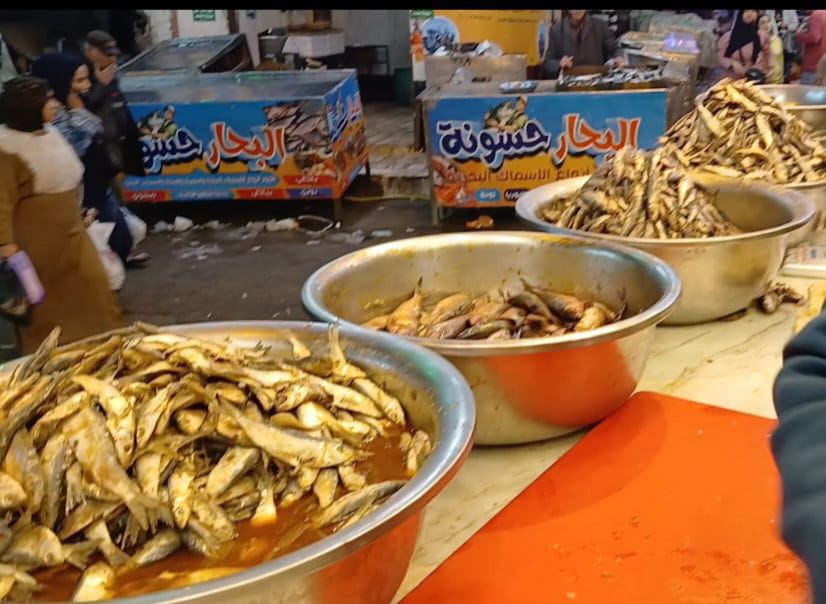
In Damanhour, the scent of salted fish announces Eid as surely as the new moon. Families crowd the narrow alleys of the city’s famous feseekh market to buy what many call the “fruit of Eid”,a tradition stretching back to the pharaohs.
By Mahmoud Dueir
As Eid al-Fitr approaches, the streets of Damanhour transform into a scene of joyful chaos. The scent of salted fish mingles with the calls of vendors, the shouts of children searching for new clothes, and the laughter of families. At the heart of it all stands the city’s famous feseekh market, a beloved landmark that comes alive each year as families prepare for the holiday.
For many Egyptians, salted fish is the “fruit of Eid,” the first food they eat after a month of fasting. It is an ancient social ritual, passed down through generations, that no amount of modernization has erased.
A Taste of Ancient Egypt
Feseekh is one of Egypt’s oldest foods. Its origins trace back to the pharaohs, who mastered the art of preserving fish with salt and drying. The preferred fish was mullet, brought from the waters of the Mediterranean Sea. This tradition became associated with seasonal celebrations and spring festivals, and it has persisted through the centuries to become an essential part of Egyptian food culture.
Damanhour, the capital of Beheira Governorate, has a long history as a commercial and cultural hub in the Nile Delta. Its ancient markets once welcomed traders from surrounding villages and towns. The city’s proximity to Mediterranean fishing grounds and the northern lakes helped its salted fish trade flourish. Family-run shops specializing in feseekh and sardines have passed their craft down through generations.
Breaking the Fast With Fish
The feseekh market sits in the heart of Damanhour. In the days before Eid, crowds become so dense that walking becomes difficult. Everyone is searching for the “fruit of Eid.” Everyone wants to break their fast with salted fish.
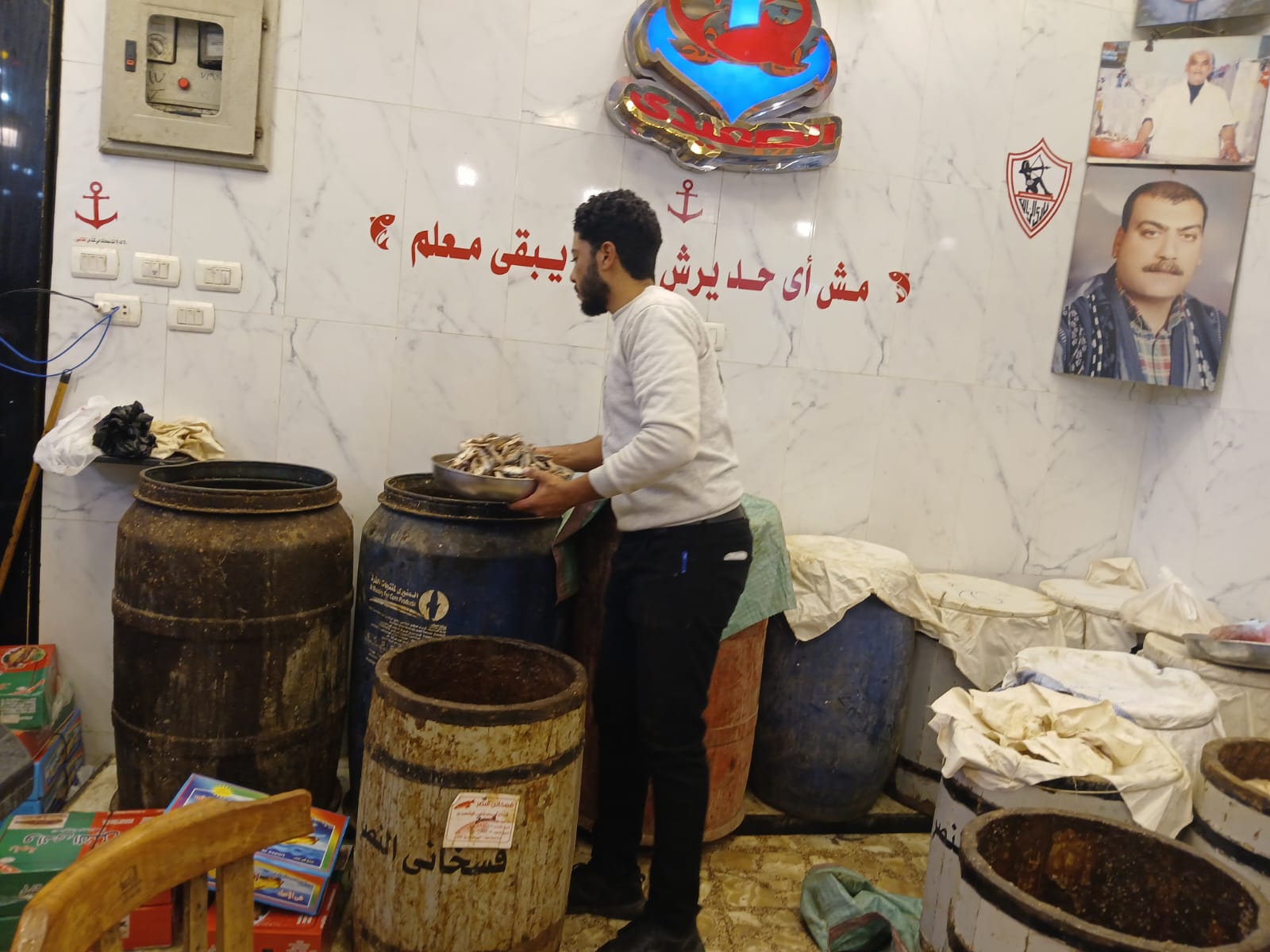
Down narrow alleys, past flickering neon signs, you reach the shops of “Feseekhani Al-Nasr,” the oldest makers of feseekh and sardines in the city. The shop was founded by Hag Ibrahim Al-Saidi 120 years ago in the same location. He was the first to import Greek herring to Damanhour.
Ashraf Al-Saidi represents the fourth generation of this family business. “The first license for the shop dates to 1912,” he says. “It was called ‘Feseekhani Al-Malek’ (the King’s Feseekh). After the 1952 revolution, the name changed to ‘Feseekhani Al-Nasr’ (Victory Feseekh).” Many other traders adopted the name later, hoping to share in the shop’s reputation. But the original remains.
The Seasons of Feseekh
Al-Saidi explains that feseekh is a seasonal food. Demand peaks at Eid al-Fitr and again at Sham El-Nessim, the spring holiday that follows. The preparation begins months earlier.
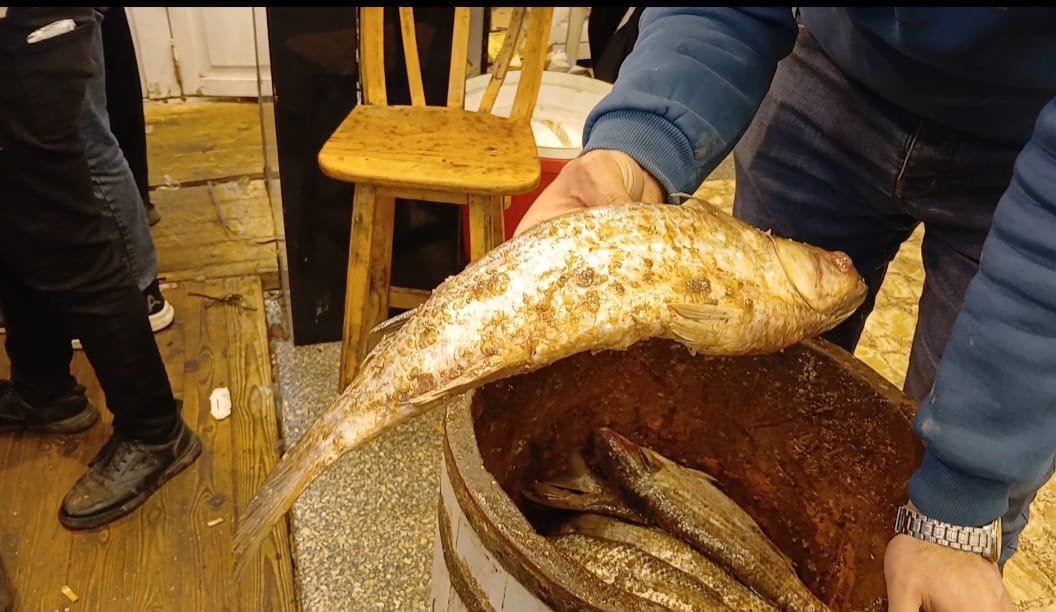
Essam, another merchant, repeats a simple principle: “Salt remains the foundation.” The first step is selecting the right fish. Not every fish is suitable for salting. The mullet or toubar must be full of flesh, properly farmed. Beyond that, the feseekh maker’s accumulated experience determines the quality.
Customers come from every social class. Because feseekh is eaten only a few times a year, people across the economic spectrum are willing to buy it. The only differences are in quantity and size. Quality does not vary.
The salting process takes about fifteen days. There are two types: fully salted and “sweet” (less salty). The sweet variety has become more popular as families watch their elders’ blood pressure. It is always in greater demand.
Essam insists on purity. “We add only salt to the fish. No nuts, no turmeric to improve the color. The craft itself produces a distinctive product.” The difference between one shop and another, he explains, lies in the source of the fish and the salting method. Each maker has their own way.
Other products include salted sardines. There are local Damietta sardines, Yemeni sardines, English banana sardines (named for their shape), and Gulf sardines. Prices range from 180 to 200 pounds per kilo.
Sardines and Their Prices
Mustafa Barghash, another feseekh maker, states simply: “Eid without feseekh or cookies is not Eid. A family’s joy is incomplete without a plate of feseekh, herring, or sardines.”
The Yemeni sardine, known as “apple” sardine, is a more recent arrival to the market. Initially, it did not attract much attention. Its size was large, and customers generally preferred smaller fish. But after tasting it, people discovered its quality. It is distinctive for its red interior, which is why it is called “apple.”
This year, feseekh prices range from 380 to 400 pounds for large royal feseekh. The increase from last year is modest. Some customers ask for deboned feseekh, preferring cleanliness and ease of eating. But the majority of Damanhour’s feseekh lovers prefer their fish whole. The ritual of eating it, bones and all, is part of the pleasure.
Engineer Mossad Aqda, a Damanhour resident, explains that feseekh is an ancient Egyptian custom. Its connection to happy occasions is strong: Eid al-Fitr, Sham El-Nessim, and even the month of Shaaban before Ramadan, when it is eaten in what is called “Shaaban.” He prefers the less salty variety for health reasons.
Diya El-Din Ali agrees. “Eating feseekh on Eid is a fixed tradition,” he says. “We look forward to it. The children love it. Sometimes we also buy it in Shaaban.”
