


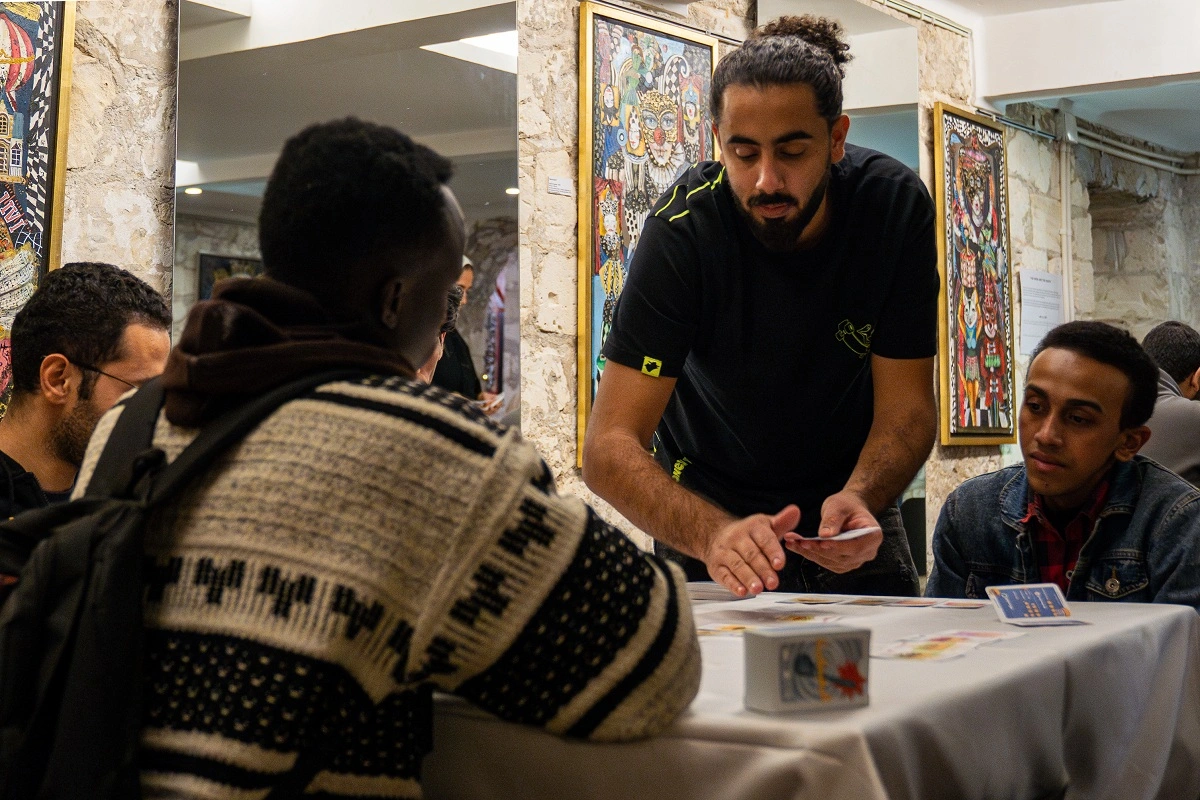
In Alexandria, a new card game called Komsha is doing something unusual. It uses South Sudanese cuisine to create space for conversation, empathy, and a deeper understanding of a community that has long been part of the city’s fabric.
By Merna Gohar
In Alexandria, a scene can unfold that leaves us briefly disoriented. A quick moment when something is picked up from the ground, and the day continues as usual. But in the game of Komsha, that moment does not pass easily. It becomes a rule imposed on the player, changing the course of play.
Here, the stories of South Sudanese people are not simply told. They are lived.
The Game as an Invisible Space
Alexandria is often described as a multicultural city, where coexistence seems almost natural. But some stories remain invisible, never finding enough space to be told. Komsha attempts to open that space, not through direct explanation but through experience.
The team behind the game describes these moments as turning points within the play. Participants, especially South Sudanese players, begin to talk about food and the memories tied to it. As if the game opens a door to conversation that was not open before.
In this context, details we might overlook in our daily lives come into focus. For some, these details are not so simple. Through Komsha, they become small but revealing moments. According to the team at ACT (Ariu for Consultancy and Training), which developed the game, the goal was to create a space for sharing South Sudanese culture.
When “The Ruling” Appears
Through a “Ruling” card, the game attempts to convey some of the daily challenges faced by South Sudanese people in Egypt, where a large community resides in Cairo and Alexandria. During play, this card appears at specific moments, changing the course of what is happening between players. The rhythm of the game shifts.
These rulings are neither random nor imaginary. They are drawn from everyday situations in markets, on public transport, and in dealing with services. The cards place players in an uneven position. They might lose a turn, rely on another player, or be forced to make a decision not in their favor. Rather than explaining these experiences, the game places you inside them, if only for a few minutes. At the same time, it does not only speak about the lives of South Sudanese people. It asks a broader question about how we deal with difference within our own cities.
A Game About Food, and More
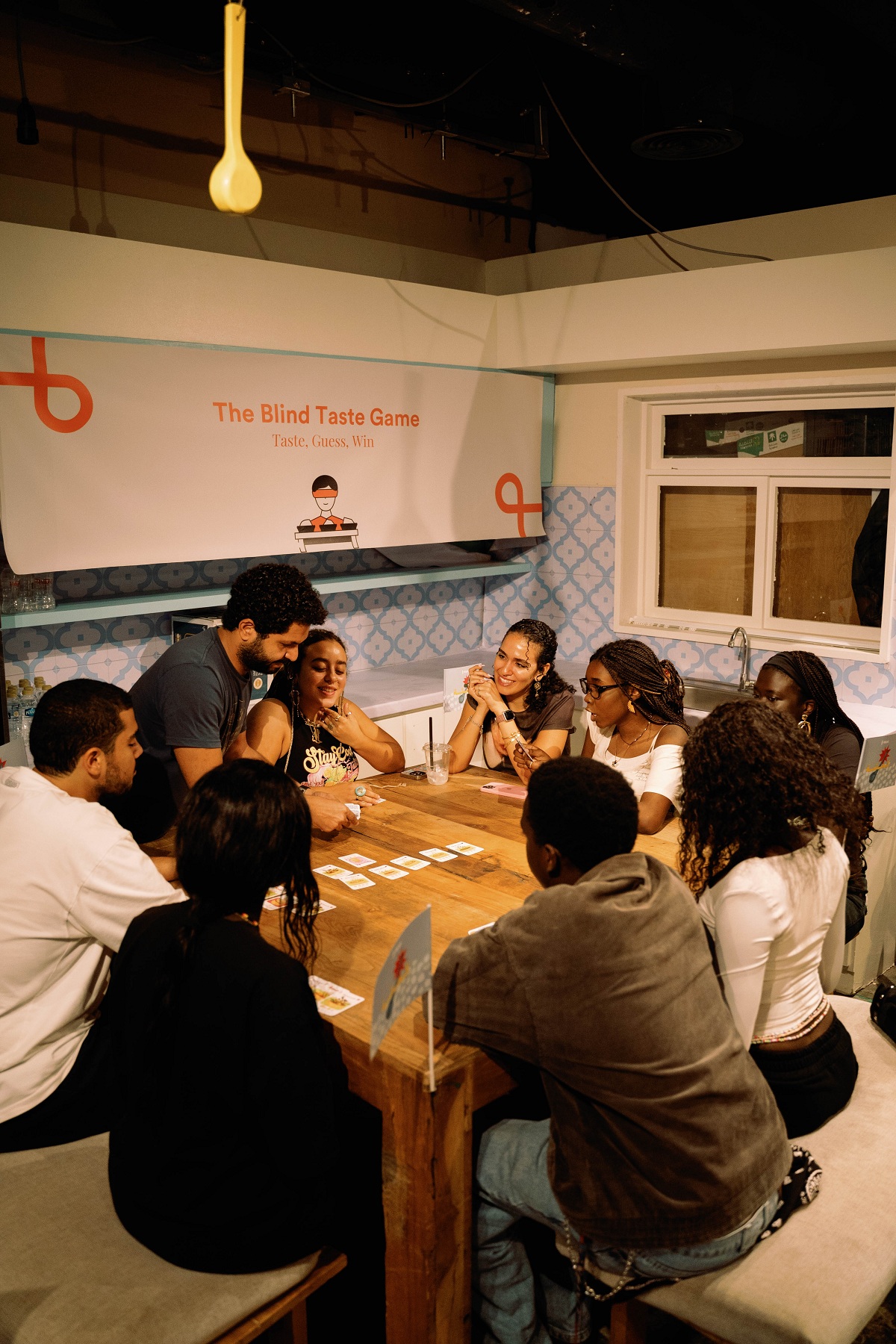
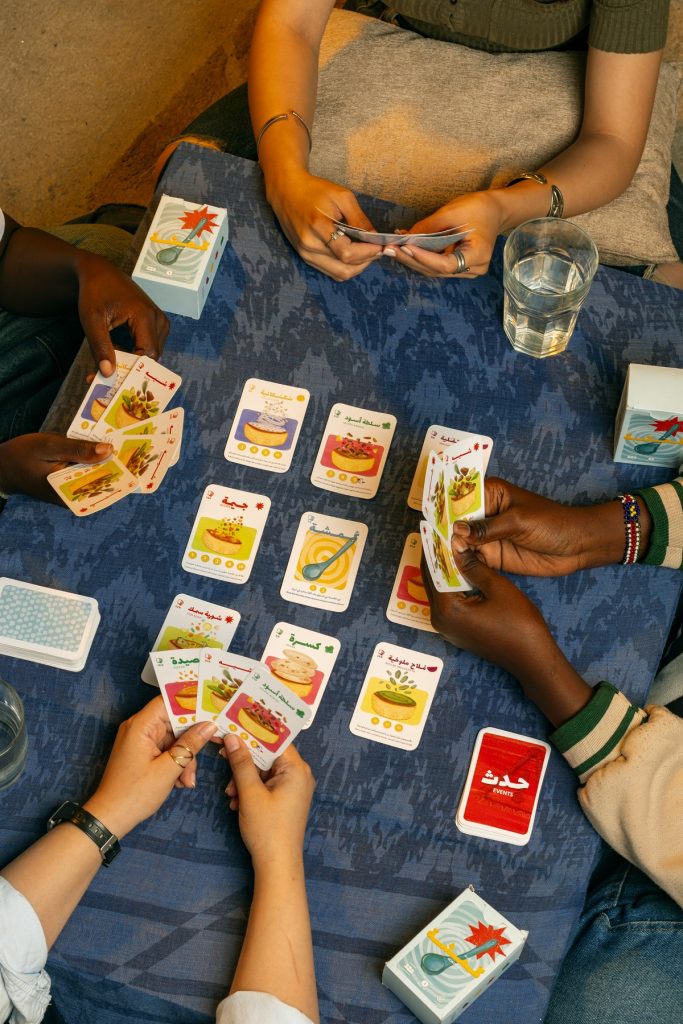
Komsha means “ladle” in Juba Arabic, a hybrid language that draws on Arabic. The game is a card game inspired by South Sudanese cuisine. On the surface, it is simple. Three to five players. Fifteen dish cards placed on the table each round.
Players draw cards, trying to collect sets of the same dish to earn points. The player with the most points wins. The dishes are divided into different sections, like a small menu reflecting the diversity of South Sudanese cooking.
The team explains that some of these dishes may seem familiar to Egyptians. Molahat, which resembles Egyptian tawagen casseroles, and kisra, similar to eish merahrhah flatbread. But they differ in preparation and ingredients. Other dishes, like molokhiya stew with dakwa (peanut butter), may seem unfamiliar but are essential to this cuisine.
From Idea to Experience
The game appears to be about collecting points, but it actually opens a window onto a culture we pass by every day without seeing. The idea for Komsha emerged from ACT in Alexandria, a company focused on training, educational tools, and community development.
But the game did not begin as a game. In one workshop that brought together children from Egypt and South Sudan, communication was not easy—different languages, different backgrounds, limited interaction. Then art entered the space. Through activities like dance, South Sudanese children began to express themselves freely. Gradually, Egyptian children joined in. Hesitation turned into interaction, then into indirect dialogue. There was no explanation, but there was understanding.
From Workshop to Table
Research followed, through discussion sessions with South Sudanese people to understand their daily experiences and challenges. Then came a game design workshop, bringing together designers, community development workers, Egyptians, and South Sudanese participants. Several ideas were proposed before the group settled on Komsha.
The choice of food was not random. The team observed that food, along with dance, is one of the most powerful forms of expression for South Sudanese people. Here, food becomes more than sustenance. It becomes an uninterrupted language of conversation.
More Than a Game
Alexandria has long been presented as a city of diversity and cultural convergence. But initiatives like Komsha ask a different question: is this diversity still present in the details of daily life, or does it need to be rediscovered?
At the same time, these initiatives do not stop at the city’s limits. Ideas born in Alexandria speak to a broader reality across Egypt. The same questions about coexistence, understanding, and shared spaces between different communities are repeated everywhere.
In the end, Komsha is not just a card game. It is a small experiment that begins with collecting dishes and ends with larger questions. It may not change what happens outside the game table. But it opens a door to understanding the hidden aspects of the lives of those who live alongside us. It brings us closer to their stories, their dreams, and the flavours that carry them.
