


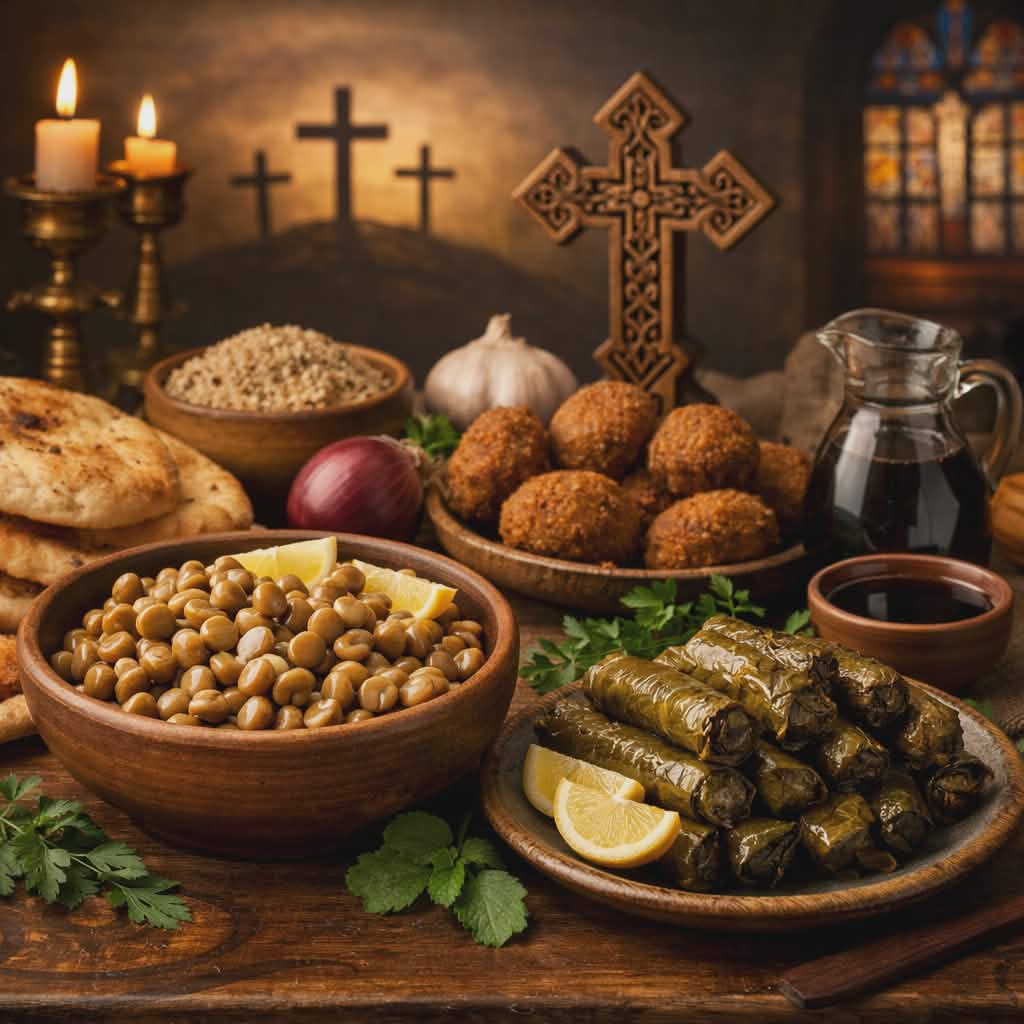
From the symbolic rebirth of sprouted fava beans to the solemn taste of vinegar, explore the deep-seated culinary traditions and spiritual rituals that define Holy Week for Egypt’s Coptic community.
By Mahmoud Dowair
In the Christian calendar, few periods carry the weight or the solemnity of Holy Week. Marking the culmination of Great Lent, these final days serve as a spiritual bridge to the Feast of the Resurrection. It is a week defined by deep interiority, as the faithful retrace the final footsteps of Jesus, from the agony of the crucifixion to the silence of the tomb through a sequence of rituals rooted in profound reverence and quiet contemplation.
Customs and Traditions Defined by Asceticism and Self-Reflection
Throughout this week, a palpable sense of asceticism takes hold as the faithful consciously withdraw from the distractions of joy and luxury. It is a season of profound interiority, an opportunity to draw closer to the divine through self-reflection and a recommitment to the ancestral traditions that have anchored the Christian community for generations. This devotion manifests in every facet of life, from the solemnity of the sanctuary to the modest patterns of the daily table.
In the churches, Holy Week unfolds through a series of distinctive rituals marked by awe and a heavy solemnity. The “Pascha” prayers, held in succession each morning and evening, guide the congregation through the biblical narrative of the Passion from the triumphant entry into Jerusalem on Palm Sunday to the stark silence of the tomb. Mournful melodies fill the incense-heavy air, and in moments of symbolic grief, the lights are extinguished, leaving the faithful to linger in prayer and contemplation for hours within the stone walls.
On “Maundy Thursday,” the atmosphere shifts to one of solemn intimacy as the liturgy commemorates the Last Supper and the establishment of the Eucharist. In a poignant display of humility, priests perform the ritual washing of feet, mirroring Christ’s own gesture of love toward his disciples. The spiritual intensity reaches its zenith on “Good Friday,” where the hours are marked by prayers that meticulously recount each stage of the crucifixion, accompanied by funeral dirges that evoke the gravity of the sacrifice.
By “Holy Saturday,” the tide begins to turn. The liturgy starts to transition from the depths of sorrow toward a burgeoning sense of hope, with readings that herald the victory over death. As the day wanes, the air of mourning begins to lift, and preparations for the Feast of the Resurrection commence, a gradual return to joy after a long, disciplined journey of fasting and meditation.
Sprouted Beans and the Symbolism of Life Emerging from Death
Beyond the ecclesiastical rites of the church, Egyptian Christians observe a tapestry of inherited folk customs that carry profound significance, particularly regarding the culinary traditions of Holy Week and the specific meals shared by families during this time.
Victor Nassim, an accountant, explains that for Copts, fasting is not merely an act of solidarity with the poor; it is a spiritual discipline intended to draw one closer to the Divine through the renunciation of worldly desires. He notes that Holy Week possesses a singular character, marked by an abstinence from sweets, sugars, and appetisers. True fasting, he emphasises, is rooted in rigorous self-discipline rather than the mere avoidance of food; the fasting person should ideally refrain from craving any specific dish.
He adds that many Christians in Egypt are meticulous about consuming sprouted beans on Good Friday. The beans are wrapped in cloth for three days until they sprout a process that serves as a powerful metaphor for burial and the subsequent emergence of new life, a symbolic nod to the Resurrection. Nassim further explains that following a period of total abstinence from food extending from midnight until six o’clock in the evening on this day some partake in a small amount of vinegar, an act of emotional communion with the suffering of Christ.
Popular Customs, Not Ecclesiastical Mandates
Dr. Mina Azer affirms that while Holy Week constitutes the final stretch of Great Lent, many of the associated culinary habits are cultural traditions rather than binding church rituals. They are expressions of a broader societal heritage, akin to the practices found in other seasons and festivals. Nevertheless, these customs carry deep symbolic weight for the faithful, reflecting their spiritual intimacy with the occasion.
Chief among these traditions is the consumption of spouted beans on Good Friday. The symbolism is striking: life emerging from death, mirrored by the bean seeds that return to growth after being submerged in water. It is a domestic reflection of the Resurrection, which remains the cornerstone of the Christian faith.
Laura Halim explains that during this week, anything suggesting joy or luxury including sweets, nuts, preserves, and appetizers is strictly avoided. An atmosphere of somber contemplation prevails; many women commit to wearing black attire when attending church services, a visual testament to their participation in this shared spiritual gravity.

Freek and its Connection to Job’s Wednesday
Laura points out that specific days carry their own distinct culinary markers, such as the consumption of Freek (cracked green wheat) on “Job’s Wednesday” and the preparation of remarkably simple meals on “Maundy Thursday.” Yet, it is Good Friday that remains the most sombre and impactful day of the week. Across Egypt, many observe a strict, abstinent fast, breaking it only with humble fare like sprouted beans.
She adds that following the quietude of “Holy Saturday,” the focus shifts toward the arrival of the Feast of the Resurrection. After a sustained period of mourning and meditation, an atmosphere of joy gradually returns to both the sanctuary and the home.
Falafel and the Symbolism of the Seal
For many households, the table becomes a canvas for the week’s spiritual journey. Hanan Abdel Malak explains that specific foods, like grape leaves, are traditional on Good Friday, but it is the falafel that carries a unique symbolic burden. To some, its round form represents the heavy seal of the tomb, while the sprouted beans signal the life stirring within. Together, they reflect the profound transition from mourning to hope that defines the Coptic experience.
