


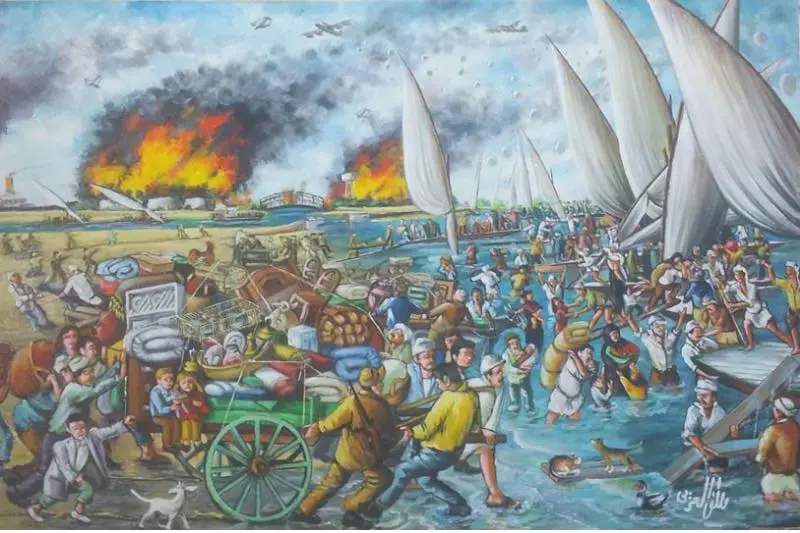
The visual legacies of Mustafa El-Azaby and Awad El-Khouly, the two master painters who captured the evolving spirit, resistance, and daily rhythms of Egypt’s Suez Canal cities through a lens of memory and academic rigor.
Every year on the fifteenth of April, as the world observes World Art Day to honor creativity as a bridge between an artist’s interiority and their society, our attention is drawn to the legacies of Awad El-Khouly (1950–2021) and Mustafa El-Azaby (1944–2015). Their canvases did more than depict scenes; they drafted manifestos of identity along the banks of the Suez Canal.
The trajectories of El-Azaby and El-Khouly represent watershed moments in the history of contemporary Egyptian art, specifically in their Herculean feat of documenting life in Port Said and Ismaïlia. Through two distinct temperaments one an intuitive, self-taught fitri (innate) style and the other a disciplined academic rigor they succeeded in distilling a visual identity of the Canal Cities’ daily rhythms, transmuting fleeting moments into enduring visual texts.
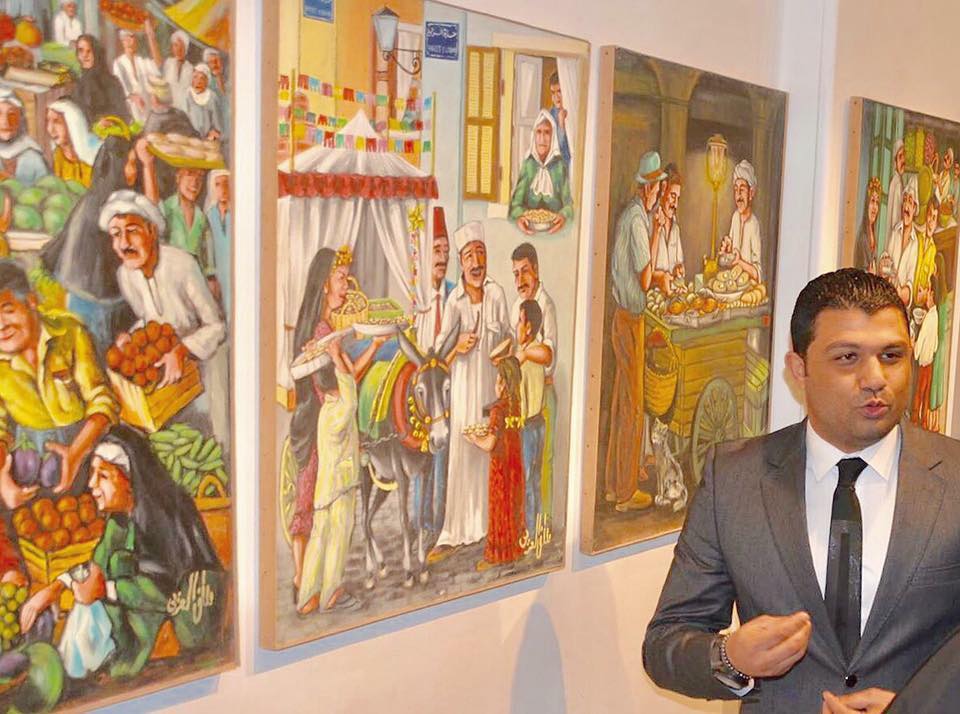
In Port Said, El-Azaby utilized his raw, spontaneous talent to archive the city’s mid-twentieth-century pulse. His brush salvaged trades teetering on the brink of extinction or those already swallowed by time, such as the Jami’ al-Rubabikia (the traditional roaming junk collector), the Kalobati (gas lamp lighter), and the Mubayid al-Nahhas (copper polisher), all set against the backdrop of Port Said’s historic corridors. Meanwhile, in Ismaïlia, Awad El-Khouly emerged with a formidable talent anchored by formal academic study. He dedicated his craft to folk heritage and the symbiotic bond between man and his surroundings. El-Khouly’s influence extended further as he designed the emblems for the city’s most prestigious festivals, celebrating folk arts and documentary cinema.
The Artist as a Product of Environment
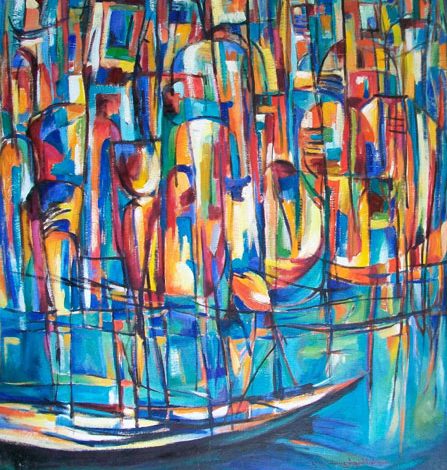
“An artist is the child of their environment,” says Khaled Khaled, head of the Fine Arts Department at the Ismaïlia Arts Center. “In the Canal Cities, with their coastal nature, creators are inevitably shaped by the life of the sea, the silhouette of boats, and the sprawling greenery of open gardens and trees. A serene landscape bleeds into the artist’s psyche, and they become a reflection of that stillness.”
He continues: “This is where the personality of Awad El-Khouly shines. He was profoundly influenced by the nature of Ismaïlia where he lived, which manifested as a deliberate calmness in both his compositions and his dialogue with color.”
Khaled emphasizes El-Khouly’s academic pedigree, noting his studies at the Faculty of Fine Arts in Alexandria. There, he was further influenced by the Mediterranean and its quietude. Though he remained rooted in Ismaïlia, his contributions rippled through the artistic life of Cairo, and his works now reside in the permanent collection of the Museum of Modern Egyptian Art.
The Imprint of Nature
In Port Said and Ismaïlia, the procession of ships through the Suez Canal, the dance of fishing boats, the cacophony of fish markets, and the storied history of wartime resistance transformed fine art into a documentary vessel. It did not merely record the visual spectacle of military triumphs; it captured the intimate lives of the common folk moving through alleys and marketplaces. The celebration of World Art Day on April 15th a date chosen by UNESCO to commemorate the birth of Leonardo da Vinci serves as a poignant reminder to revisit these contributions.
El-Azaby: Archiving the Soul of Port Said
Mustafa Abdu El-Azaby (1944–2015) stands as a singular figure who harnessed his palette to chronicle the city’s evolution. He translated the streets and quarters of Port Said into frames that captured the city’s psychological shifts: from the fierce resistance of 1956 to the bitter pangs of tahjir (forced displacement) in 1967, and finally to the triumphant crossing of October 1973 and the subsequent era of reconstruction.
In a profile published in Al-Khayal magazine in July 2012, archived by the Fine Arts Sector, El-Azaby reflected on his origins: “I have been enamored with art since childhood. My first mentor was the folk artist Taha Shehata, who used to decorate the facades of homes in Port Said to celebrate the Hajj (pilgrimage) season. While he worked atop a ladder, I would draw on the ground below. Passersby were mesmerized by my sketches, despite my tender age.”
A Gallery Upon the Waves
El-Azaby described a pivotal shift in his career when he took a position aboard an oil tanker. In the quiet pockets of his maritime duties, he returned to his sketches. His work caught the eye of the ship’s Greek captain, particularly his renderings of Egypt, the Pyramids, and the Sphinx. The captain proposed an exhibition on board; the ship’s infirmary was converted into a gallery where El-Azaby’s canvases were hung, traveling with the vessel to the great ports of the world.
What distinguishes El-Azaby’s work is his meticulous attention to the architecture of clothing and character. He blended an intuitive touch with expressive realism, grounding each painting in a specific geography a particular street, a square, or a shoreline. He recreated these spaces as they stood in the 1940s and 50s, obsessed with the veracity of backgrounds and the vitality of the faces in the crowd, ensuring the heartbeat of the era remained audible.
El-Khouly: Seeing the Lake from the Other Shore
In contrast to El-Azaby’s self-taught journey, Awad Mohamed Mustafa El-Khouly (1950–2021) stood as the quintessential academic who never allowed formal training to sever his connection to his popular roots. Born in Ismaïlia on February 19, 1950, he honed his craft at Alexandria University’s Faculty of Fine Arts, earning his degree in painting in 1975.
El-Khouly navigated both creative and administrative waters, serving as the president of the Fine Arts Club in Ismaïlia and leading the Fine Arts department at the Ismaïlia Arts Center. He also lent his vision to the printed word as an art director and illustrator for journals such as Al-Thaqafa al-Jadida (New Culture) and Al-Murjan.
A Divergent Vision
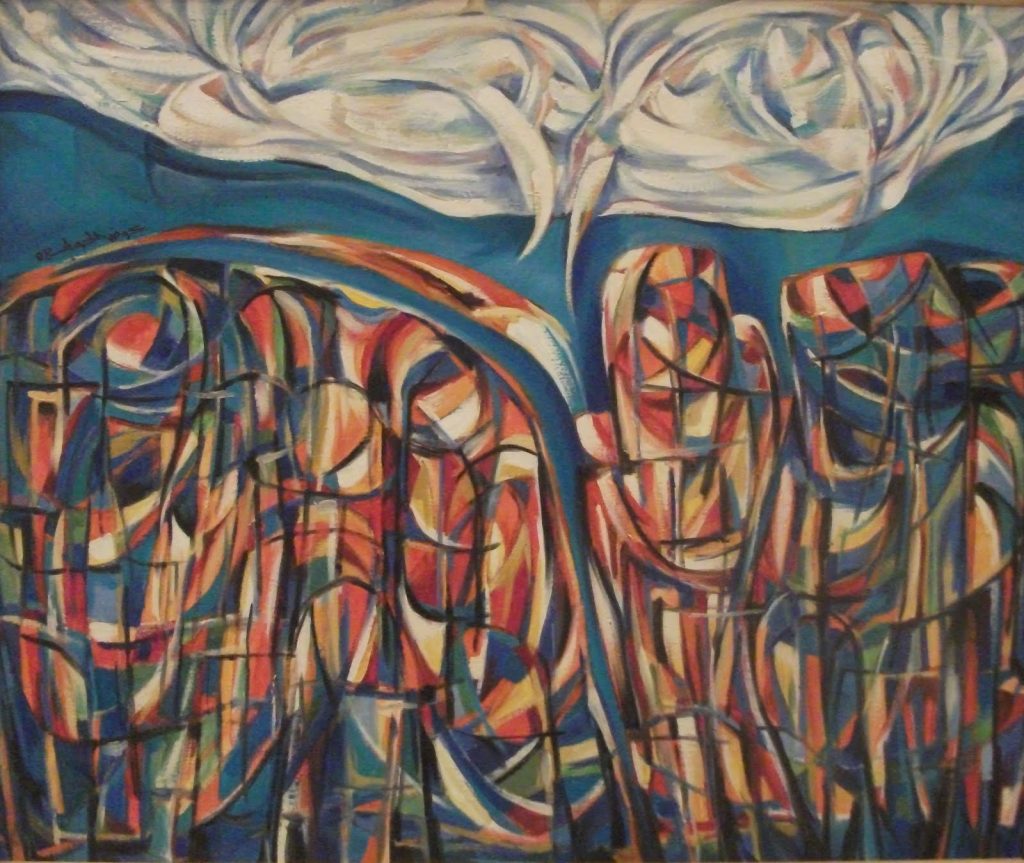
In an interview during the “Art Street 6×6” exhibition in 2011, El-Khouly remarked: “I seek a vision that diverges from what we standardly perceive of Lake Timsah. The scene is magnificent when you sit on the shore at sunset, but for this collection, I inverted the perspective. I looked at the city from the vantage point of a boat sailing within the lake.”
In a triptych presented during that exhibition, El-Khouly offered this altered reality of Lake Timsah and the lives of its fishermen. A deep, pervasive blue washed over his works, imbuing them with a tranquility that anchored the viewer’s gaze despite the intrusion of hot red and orange lines. At first glance, the compositions appear as a lattice of chaotic, intersecting strokes; yet, with a moment’s contemplation, they reveal a world of figures that seem to breathe and move within the frame. El-Khouly believed that art is a reflection of the intricate web of human social and environmental relationships. His philosophy radiated from the concept of al-mawruth (heritage) or the “trace,” striving to achieve a localized authenticity. At the intersection of these paths stands the Suez Canal the ultimate engine of creativity for both El-Khouly and El-Azaby.
Divergent Paths, Unified Creation
Though their educational backgrounds were disparate one talqa’i (spontaneous) and the other academic the environments of Port Said and Ismaïlia brought them into a shared orbit of vision and purpose. Each, in his own tongue, found in his surroundings a source of inspiration and a vessel for preserving identity.
Both artists endured the trauma of displacement following the 1967 war, an experience that haunted their work. El-Azaby sought to resurrect the Port Said of old as an act of mnemonic resistance, while El-Khouly’s work, particularly his iconic festival logos, served as a vibrant testament to the endurance of joy and the continuity of life.
