


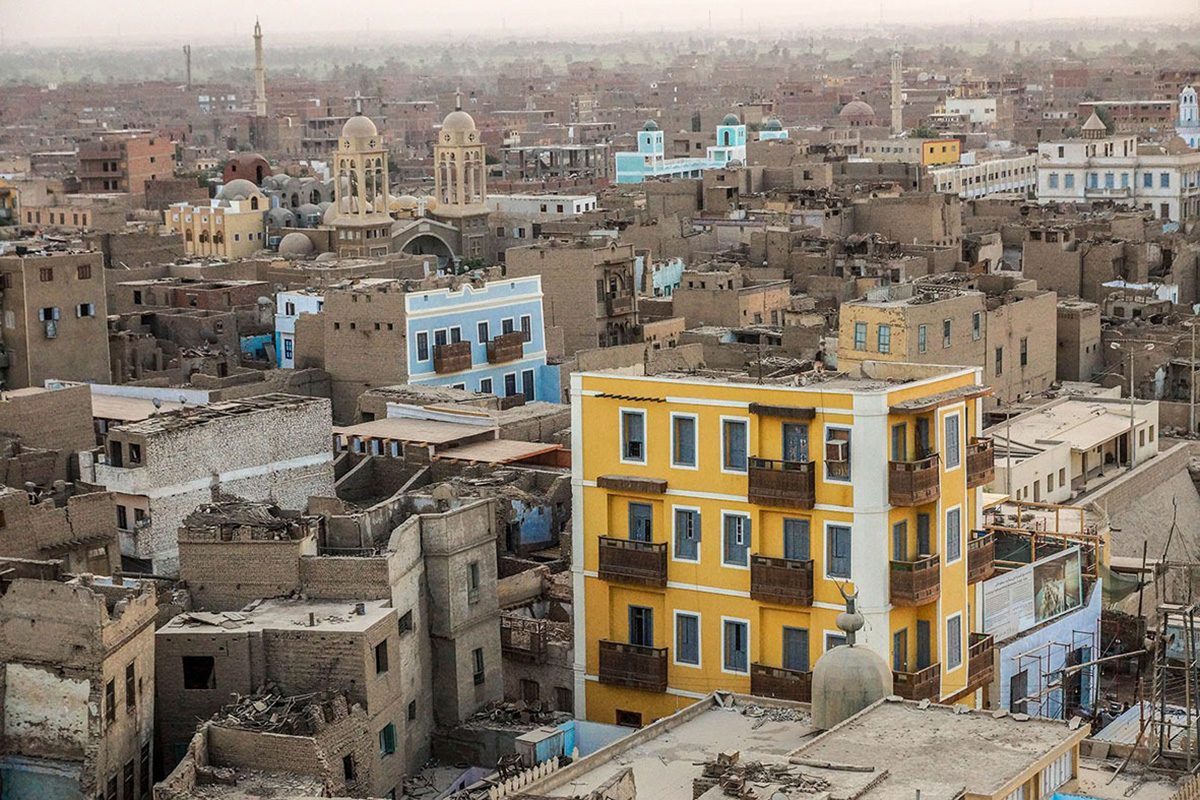
The city of Esna, located south of Luxor, has brought Egypt back into the global architectural spotlight after the Agha Khan Architecture Award’s jury announced that the “Revival of Historic Esna” project had won the 2025 award. The award is one of the most prestigious international awards in the field of architecture and urban conservation, bringing Egypt back to the podium after an absence of more than twenty years since its last similar achievement, the Bibliotheca Alexandrina in 2004.
A comprehensive vision for development
The winning project is not limited to the traditional restoration of monuments. It adopts an integrated model that combines the preservation of urban heritage with the revival of economic and cultural activities. It was implemented by the Takween Foundation for Integrated Community Development in collaboration with the Ministry of Tourism and Antiquities and the Luxor Governorate. It was supported by international partners, most notably the governments of the United States, the Netherlands, and Spain.
The jury described the experience as going beyond the ordinary. It focused on involving the local community as the main actor in preserving the city’s identity. It emphasized that “the residents themselves have become the architects of the urban revitalization process through their living heritage.”
From a forgotten city to an attractive destination
For decades, Esna remained off the tourist map, limited to the Temple of Khnum. Meanwhile, its buildings and markets suffered from deterioration. However, the project managed to redraw its image through a series of interventions, including:
- Restoring the Al-Jadawi archaeological agency and opening it for the first time in 70 years.
- Developing the traditional Qaisariya market in collaboration with local merchants.
- Improving services at the Temple of Khnum and integrating it with the national restoration plan.
- Restoring King Farouk’s Rest House and the facades of 15 buildings and other heritage sites.
- Reorganizing the historic market street and adding shaded public spaces.
In addition, the project created hundreds of jobs and trained more than 400 young people and women in traditional crafts, restoration work, and tour guiding. It also documented more than 20 heritage buildings and 25 local recipes. It launched small women-led economic initiatives such as “Okra Kitchen” and “Woodworking Workshop.”
Economic and social impact
These efforts have resulted in a more than threefold increase in the number of visitors to the city. This has reestablished it as a cultural destination rich in historical layers, from the Greco-Roman era to the Islamic and modern periods. The project has also reinforced the role of heritage as a tool for social inclusion and sustainable economic development.
Engineer Karim Ibrahim, the project manager, emphasized that the award does not only honor the architectural design. Rather, it proves that “architecture can be a driver of development and a catalyst for strengthening the spirit of the local community.”
In a special statement to Bab Masr, he added that the revival of the historic city of Esna won the Aga Khan Award for Architecture after meeting the extremely difficult conditions set by the international jury. These conditions can only be met by projects that adhere to the highest standards of quality and sustainability. He emphasized that the importance of the award lies in the fact that it is a global reference that can be used to guide the implementation of similar projects that meet the required standards. He extended his congratulations and thanks to the people of Luxor and Esna, as they are the real reason behind this success.
Esna on the global tourism map
Ibrahim pointed out that winning this prestigious award will contribute to putting Esna back on the global tourism map. The world will recognize its historical and cultural value, which will attract more visitors in the coming period. He explained that the project would not have achieved this result without significant government support, noting that the Prime Minister visited the project site twice, first in 2021 and then in 2024. This reflected the state’s interest in following up on the implementation steps on the ground.
He added that the success achieved in Esna will be a model that can be replicated in other cities within Egypt. Such as Rashid, Qusair, and Qus, where proposals will be submitted to the government to implement similar projects in those areas. He considered that this approach represents a real opportunity to revive historical and heritage cities in Egypt. This will reflect on the development of local and global tourism and enhance the value of Egyptian identity around the world.
Government and community partnership
Engineer Abdel Muttalib Mamdouh Amara, Governor of Luxor, emphasized that the award is in line with the state’s plans to develop infrastructure and tourism in Upper Egypt. He pointed to the project to develop the 1,260-meter-long Esna Corniche and transform it into a cultural destination featuring a river walkway, bazaars, and public gardens.
Egypt’s return to the award map
The Aga Khan Award was launched in 1977 to encourage projects that strike a balance between architectural creativity and responding to the needs of communities. Egypt has won it on seven previous occasions, most notably for the Nubia Museum (2001) and the Bibliotheca Alexandrina (2004). However, its projects have been absent from the shortlists for the past two decades.
Therefore, Esna’s victory represents a turning point that restores Egyptian architecture to its international position. It provides a model for other cities seeking to strike a balance between preserving their historical identity and building a more sustainable future.