


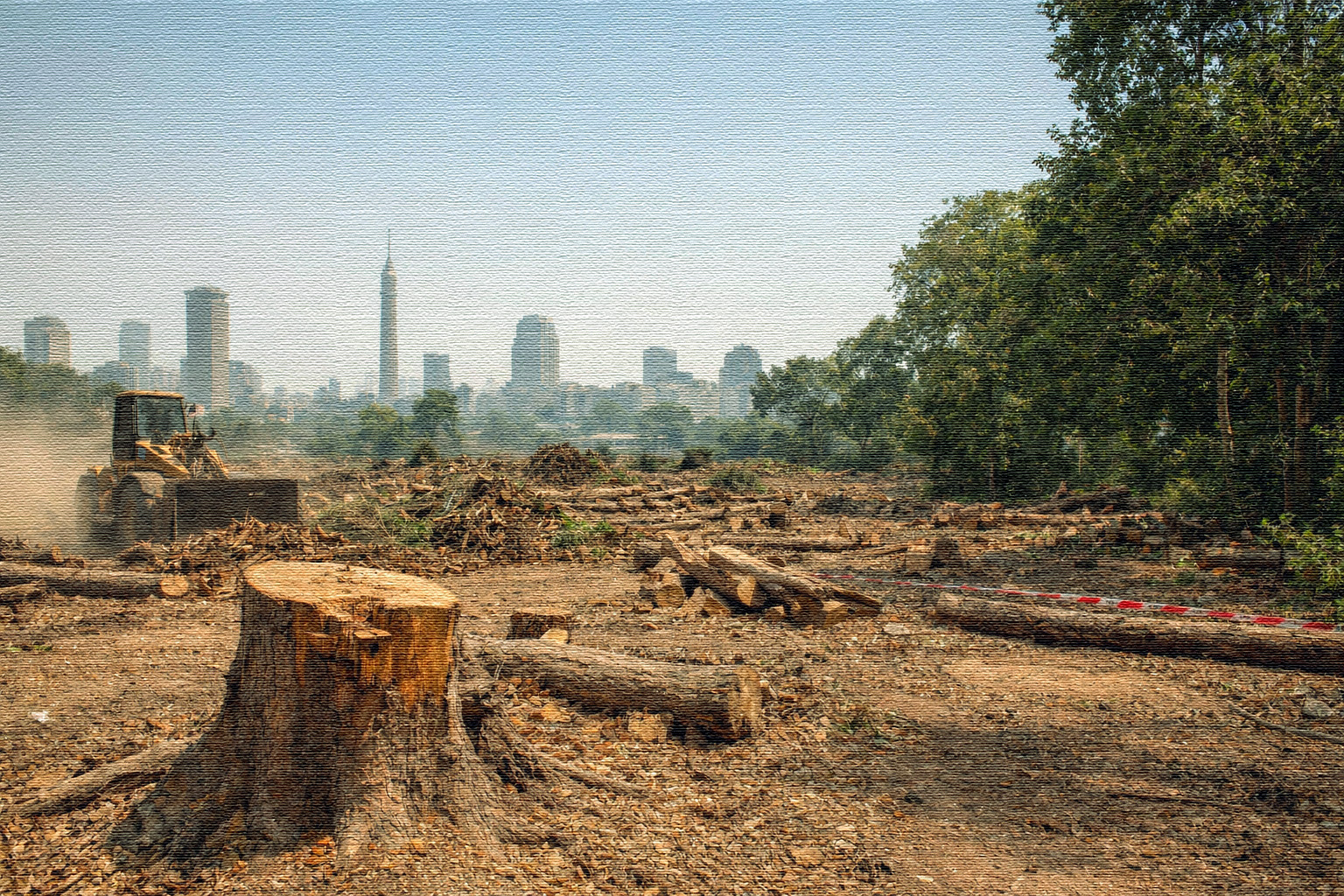
An investigation into the environmental, social, and political consequences of deforestation across Greater Cairo.
Residents of Greater Cairo increasingly sense a dramatic shift in the city’s urban climate. Across Cairo, Giza, South Qalyubia, and their expanding peripheries, people speak of rising temperatures, thickening pollution, and a suffocating dominance of dust and smog. Over the past decade, this feeling has intensified alongside an aggressive campaign of tree removal carried out under the banner of urban development. The result is what many describe as the cementing of the city: the steady disappearance of green spaces, the relentless bleeding of tree cover, and the overwhelming spread of concrete, all while state-promoted greening initiatives lag far behind the pace of destruction.
A City Designed for Cars
Tree-cutting campaigns have swept almost every corner of Greater Cairo, driven by a planning logic that prioritizes cars over pedestrians. Streets have been widened far beyond necessity, transformed into quasi-highways slicing through dense urban neighborhoods. To make room, roadside trees have been uprooted, and once-lush central medians flattened. Even historic cemeteries have not been spared, as thousands of tombs and their surrounding vegetation have been erased to accommodate new roads and infrastructure projects.
In Heliopolis, Abdul Aziz Fahmy Street, once celebrated for its dense tree canopy, now stands stripped and bare. In Nasr City, significant portions of Lotus Garden were cleared to construct a multi-story parking garage. Meanwhile, large areas of Merryland Park were bulldozed during redevelopment efforts. According to a statement by Asmaa Al-Hallougi, head of the Association of Tree Lovers, more than 311,000 square meters of green cover were removed in Nasr City alone, with an additional 272,000 square meters lost in Heliopolis.
Giza: The Vanishing Green
Across the Nile in Giza, the pattern repeats. Ahmed Orabi Street in Mohandessin, once a rare green corridor, has been stripped of its trees to make way for road expansions and bridge ramps. Similar transformations have occurred along Arab League Street, where lush central medians have been reduced to barren strips of concrete, leaving pedestrians exposed to the scorching sun and polluted air.
When Development Means Erasure
More recently, Umm Kulthum Garden in Manial was entirely cleared, with plans reportedly underway to replace its greenery with cafés and commercial outlets. Official statements have done little to soften public outrage. Despite the presidential initiative to plant 100 million trees, reality on the ground suggests the opposite, a systematic removal campaign.
In December, the Egyptian platform Sahih Misr published a satellite-based study revealing that green spaces had shrunk in approximately 95 percent of Cairo’s neighborhoods over the past eight years. Gamaliya district recorded the most severe loss, with a staggering 69 percent reduction. Nine other districts lost over half their green cover. In 2024, Shubra El-Kheima, Matareya, Manshiyat Nasser, Bab El-Shaariya, Shubra, Rod El-Farag, El-Sahel, Ain Shams, and El-Zawya El-Hamra ranked among Cairo’s most deprived areas, each offering less than 25 centimeters of green space per resident. The study concluded that nearly 30 percent of Cairo’s population now sees nothing but asphalt roads and concrete bridges.
The Environmental Cost
Urban development has become the all-purpose justification for tree removal, despite the mounting environmental costs. Pollution levels in Greater Cairo have reached record highs, exacerbated by decades of mismanagement and uncontrolled urban sprawl over fertile agricultural land. Major reforestation projects, such as the long-promised Green Belt, were derailed by corruption and converted into residential developments during the Mubarak era.
In May 2023, then Minister of Environment Yasmine Fouad stated that the average Egyptian’s share of green space stood at just 1.2 square meters, far below the World Health Organization’s recommended minimum of 9 square meters. Independent estimates suggest that Cairo residents may now receive only a few centimeters each. The loss of tree cover, she acknowledged, has contributed directly to rising dust, smog, greenhouse gas concentrations, and declining air quality.
Heat Islands and Rising Temperatures
A 2023 study by Arup, the global sustainable development consultancy, ranked Cairo among the cities most affected by the urban heat island phenomenon, where dense construction and limited vegetation cause city temperatures to rise significantly above surrounding rural areas. In Bulaq El-Dakrour, which lacks nearly all vegetation, recorded temperatures were six degrees Celsius higher than those in Al-Qursaya Island, where tree cover remains relatively dense. These findings underscore the severe climatic impact of Cairo’s ongoing deforestation.
Whose City Is It?
Officials often justify tree removal by citing Egypt’s limited water resources. Yet this logic collapses when contrasted with the vast lawns and golf courses irrigated daily inside gated compounds and luxury developments. The selective application of environmental austerity raises troubling questions about whether Cairo is being deliberately made unlivable to push residents toward suburban gated communities, and whether environmental policies are serving real estate development rather than public welfare. The imbalance suggests a broader strategy of urban displacement masked as modernisation.
Beyond environmental loss lies a deeper issue of the right to the city. Urban planning decisions are being made without community participation, leaving residents powerless as their neighbourhoods are reshaped overnight. Citizens awaken to find gardens replaced by flyovers, trees substituted by concrete, and sidewalks erased. True urban development demands public consultation, environmental accountability, and social equity, not top-down policies driven by profit and speed.
Towards A Humane City
Cairo’s accelerating deforestation is not merely an environmental crisis, but a social, political, and public health emergency. Without urgent policy reversal, the city risks becoming an uninhabitable concrete sprawl. Reversing this trajectory requires immediate, large-scale tree planting, strict environmental impact assessments, and transparent urban planning. Without decisive intervention, Cairo’s remaining green traces may soon vanish entirely, leaving behind a city permanently sealed in cement.