


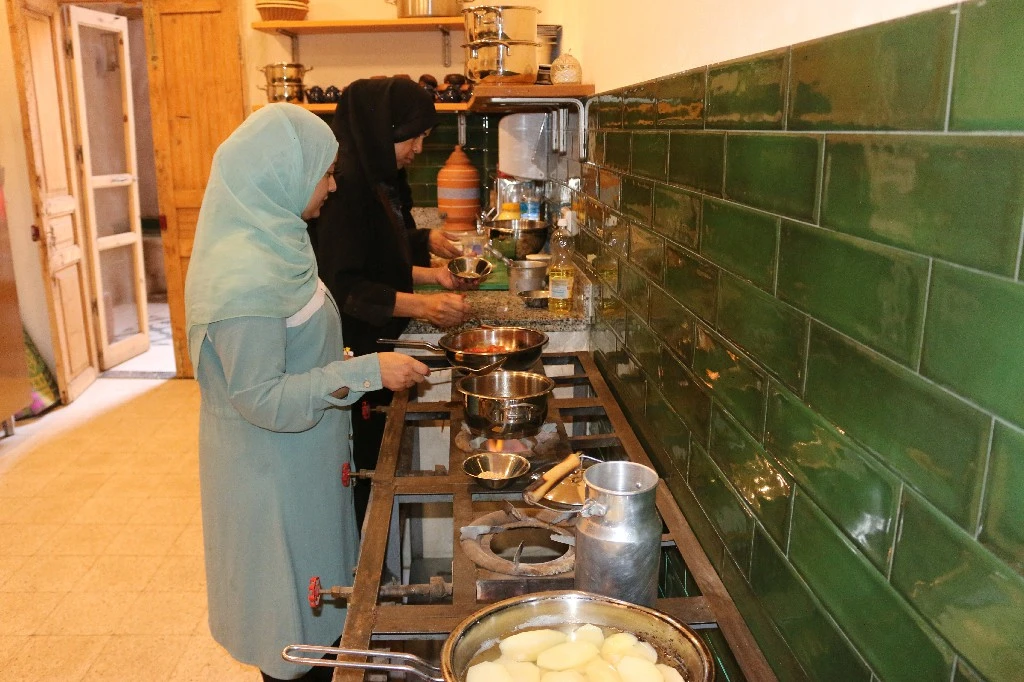
In one of the quiet alleys branching off from Khnum Temple Street in the city of Esna, south of Luxor, the smell of roast duck wafts through the air, mingling with the aroma of Esna lentils and the flavor of fish and shululu, while women’s laughter echoes from inside a small building with a mud-colored facade. and its doors decorated with simple Nubian carvings. Here stands Okra, not as a traditional restaurant, but as a women’s heritage project that has restored Esna’s lost flavor and brought the voices of its women back to the table.
Okra is the first traditional kitchen in the city, run and supervised by eight skilled women, some of whom have never worked outside their homes before.
Traditional cooking competition
They were selected by the Takween company from among 39 women who entered a traditional cooking competition, after which they underwent intensive training for a whole year with professional chefs, learning the arts of cooking, presentation, hygiene, and kitchen management as a living tourism project.
Asma al-Jundi, one of the participating women, said, “The idea started from our love of local food and our desire to offer something authentic to tourists. It’s not right for tourists to come from abroad and eat pizza or pasta. They have to taste the lentil soup, the sakhina, and the qartam tagine, which our grandmothers used to cook with love, without measuring the ingredients.”
Advance booking
The kitchen does not operate like a regular restaurant, but is open for advance bookings only, especially for tourist groups passing through Esna on tours of Luxor and Aswan.
Asmaa says: “Everything here is done on the day itself. The bread is baked and the tagines are put in the traditional oven. We welcome the guests ourselves, tell them about the food, and serve it to them with warmth before it gets too hot.”
Division of roles
The women divide their roles in the kitchen with precision. Each woman specializes in a particular type of food. For example, one woman specializes in preparing shululu, another in duck tagine, and others bake bread and prepare okra dishes.
Um Hashim Abd Rabbo adds: “There is a system here. Shululu is a dish from Upper Egypt made from dried molokhia, garlic, lemon, and cold water. It has become a surprise for tourists, who ask about the secret of its taste despite the simplicity of its ingredients. Okra, or weika as it is known here, also impresses guests.”
Adas Isnawi
Adas Isnawi is cooked in a completely different way from how it is known in other cities and is served with hot shumsi bread straight from the municipal oven.
Feryal Abdel-Rady says: “I used to stay at home, and this was the first time I had ever worked. I entered the competition on Facebook, thinking I wouldn’t win, but I did. I learned things I never imagined I would, such as how to work in a team, how to prepare a dish that looks good, and how to explain the ingredients to tourists.”
A complete sensory experience
Tourists don’t just come to eat, they come for a complete sensory experience. The kitchen is decorated with old pottery and copper pots, and visitors sit on simple wooden chairs while traditional music plays softly in the background on an old radio.
Asma says, “Some people ask us for recipes and take step-by-step photos. We are very happy that people are learning our cuisine and taking it to other countries.”
An experience that became the talk of the town
The project, which was launched in partnership between Takween and the local community, is not only for profit, but also to empower women and boost the local economy.
Asma says, “In the past, any project in the city was for men.
This is the first time we have proven that women are capable, with dignity, without giving up their customs or leaving their homes.”
The impact of Okra has not been limited to the women who work there, but has extended to the community as a whole. The experience has become the talk of the town in Esna, and other women have begun to ask about similar opportunities.
A tourist destination
The kitchen also provides a steady income for the women who work there. Over time, Okra is expected to evolve from a simple local experiment into a full-fledged tourist destination, especially after it was officially included in Esna’s tourist itinerary.
Documenting Isna’s traditional dishes
It should be noted that the idea for the competition, which was launched in August 2023, came with the aim of offering a different tourist experience in the city of Isna. Tourists often eat the same traditional foods from Cairo to Aswan without experiencing the unique characteristics of each city. Hence, the idea of documenting Esna’s traditional dishes came about.
However, surprisingly, only ten recipes could be documented. This prompted the organizers to launch a competition for women to discover traditional recipes and dishes that were in danger of disappearing. After collecting a number of these little-known recipes, which are characterized by different flavors, it was decided to establish a women’s kitchen to offer tourists traditional Esna dishes as part of a unique cultural experience. Visitors will be able to taste dishes that are not usually available in restaurants.
Visitors will taste foods that cannot be found anywhere else, such as weika, qartam, asida, ajamia, and other traditional dishes from Esna.
Read also
Two sculptors from Luxor establish the first school and exhibition to revive Pharaonic sculpture
King Farouk’s farm in Tafnis… An agricultural legacy turns into a productive treasure in Upper Egypt