


The most famous moment in which the argoul appears may be the scene in which the character Masoud, played by the late actor Samir Ghanem in the play Al-Mutzawwigin (The Married Couple), makes his entrance playing a long wind instrument at the wedding of his friend Hanafi (George Sidhom), and it later becomes clear that the groom is Masoud himself.
However, the fame of the arghul goes deeper than this theatrical scene, as it was the primary wind instrument in the performances of the popular singer Mohamed Taha (1922-1996), and was also associated with rural singing in the fields among villagers.
The arghul: the “Voice of the Authentic” initiative
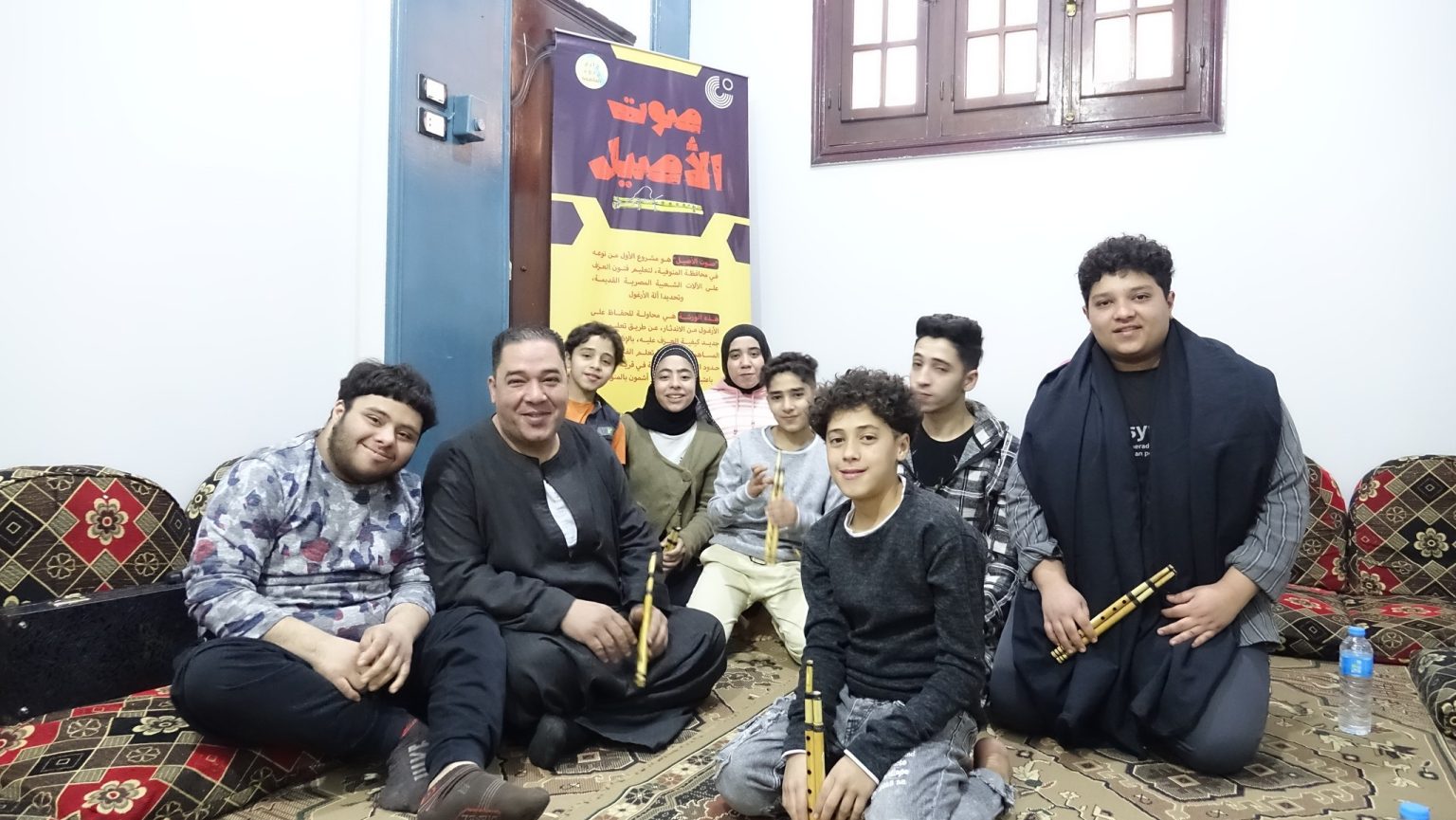
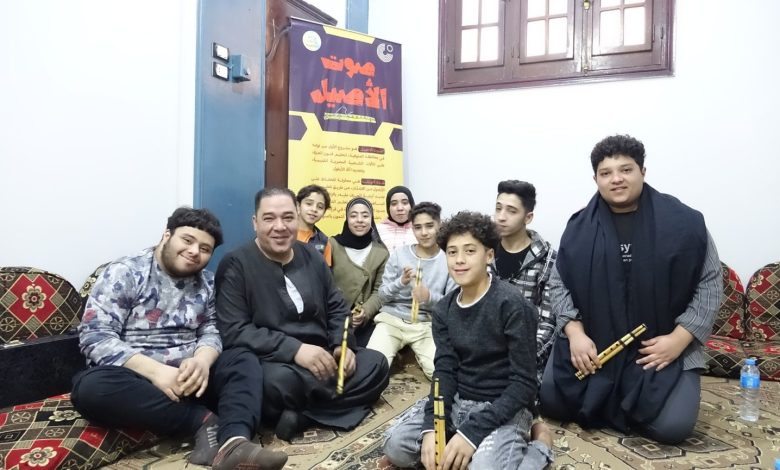
Musician Amin Shahin is currently attempting to launch the second phase of his “Voice of the Authentic” project. The aim is to teach young people to play the arghul and form an artistic ensemble. This comes after he completed the first phase with support from the Goethe-Institut Cairo’s “Beyond the Capital” project last November.
Shahin told Bab Masr – Bahri: “We meet every Friday to practice and play the arghul. This is part of the second phase of the ‘Voice of the Original’ project, so that the children can continue learning and participating in the band’s performances at official concerts.”
He describes growing up in an artistic environment in the village of Shatanoun, in the Ashmon district of the Monufia governorate. His father was a kula player, and his uncles were arghul players. He himself began learning the kula at the age of seven, after being enticed by watching his father play at parties. He then moved on to learn the arghul at a later stage. He joined the Nile Folk Arts Ensemble as a player of this instrument when he was 18.
In 2022, Shaheen launched the “Voice of the Original” project to teach the art of playing ancient Egyptian folk instruments, specifically the argul, in an effort to preserve them from extinction. This is due to the small number of players and makers, and the advanced age of the current players.
The arghul: heritage of the Egyptian countryside
In his book “In the Egyptian Countryside,” published in 1928, writer Mustafa Ali al-Halbaoui described rural music as follows: “In the countryside, life is simple and still has a rural feel, untouched by the hustle and bustle of city life. It is quiet and sleepy, steeped in the past. The only musical instruments the farmers know are the arghul, the local flute, and the salamiya. This rural music may have its own beauty.”
He adds: “The arghul and the salamiya are the only musical instruments that farmers know. They often carry their arghuls and flutes with them and sing in the quiet, dreamy fields to relieve themselves of the toil of work and to lull their sheep to sleep.”
While these instruments were widespread among farmers in the past, the “Voice of the Authentic” initiative points out that the arghul is no longer an everyday instrument in rural Egypt, which threatens its extinction as part of the living heritage.
How is the arghul made?
According to the “Atlas of Popular Traditions” published by the General Authority for Cultural Palaces, the arghul is made from reed. It consists of two reeds of equal width, joined together and parallel, one longer than the other. The longer reed can be fitted with additional connectors. The shorter reed has six holes drilled in a straight line along its wall.
At the front of each reed (at the top) is a single reed made from bamboo. The sound is produced when the player puts them in their mouth and blows. The long reed in the arghul produces a single tone that accompanies the melodies, which are produced by the short perforated reed.
The argul comes in different sizes in Egypt, the smallest being 50 cm long. The largest argul can reach 210 cm in length, but this size is rare today. Contemporary professional players are content with using the smaller sizes of the argul.
It is similar to the arghul, and comes in sizes and dimensions similar to those of the arghul. However, the qurma is made from two reeds of equal length and width, and is made without the excess part of the long reed used in the arghul. Likewise, no additional joints are fitted to the qarma in the reed that is free of holes.
The oldest musical instruments
In her book “Folk Literature,” Dr. Amani Al-Jundi described the arghul as one of the oldest musical instruments known to the Egyptians. Rural children enjoy its strong tones, which suit their mood. Boys in the countryside used to make it from thick clover sticks or hollow firewood sticks. When they grew older and their mouths became stronger, they made it from wood. They would then play it behind their sheep or cattle grazing on the bridges over the irrigation canals between the fields.
The soldier elaborates, saying, “Folk artists sing mawala on the arghul. Researchers of literary history call it mawala, and some trace it back to a slave girl of the Barmakids. She would lament them after their misfortune, mourning them and crying out ‘Wamawaliya’ at the end, and this became known as mawala.”
The future of the arghul
Amin Shahin says: “In the first phase of the ‘Voice of the Original’ project, there were about 20 child musicians aged 10-18. About half of them currently attend weekly training sessions. Some of them participate with an artistic group of the same name in performances in Monufia and Cairo, as well as events organized by the Ministry of Culture. This paves the way for new players to take up the instrument.”
He continues: “The effort to preserve the heritage of the arghul is difficult for an individual or a single band, and requires institutional support. So I applied for a grant from the Goethe Institute’s cultural department and was awarded one. I am currently working on the second phase of the project and seeking new support.”
Modern arghul
The sound of the arghul is associated with the folk singing of the mawal in rural and Upper Egypt, as heard in the mawawil of Muhammad Taha recorded on Egyptian radio. However, this association paved the way for a connection between experiences of redistributing songs in a modern way, which began after French musician Jérôme Itinger, founder of the band Al-Masra, fell in love with the instrument. He produced Sufi and traditional songs and mixed them with electronic music. The sound of the arghul can be heard in the soundtrack of the film “The Blue Elephant” and the series “Faris al-Qamar” on Netflix.
Read also
Um al-Khalul: a popular dish that became a sung heritage
Here lived French pop icon Claude François, the stranger who became the “son of Ismailia”
